Step 1 decision
Dry-brine the centre cuts
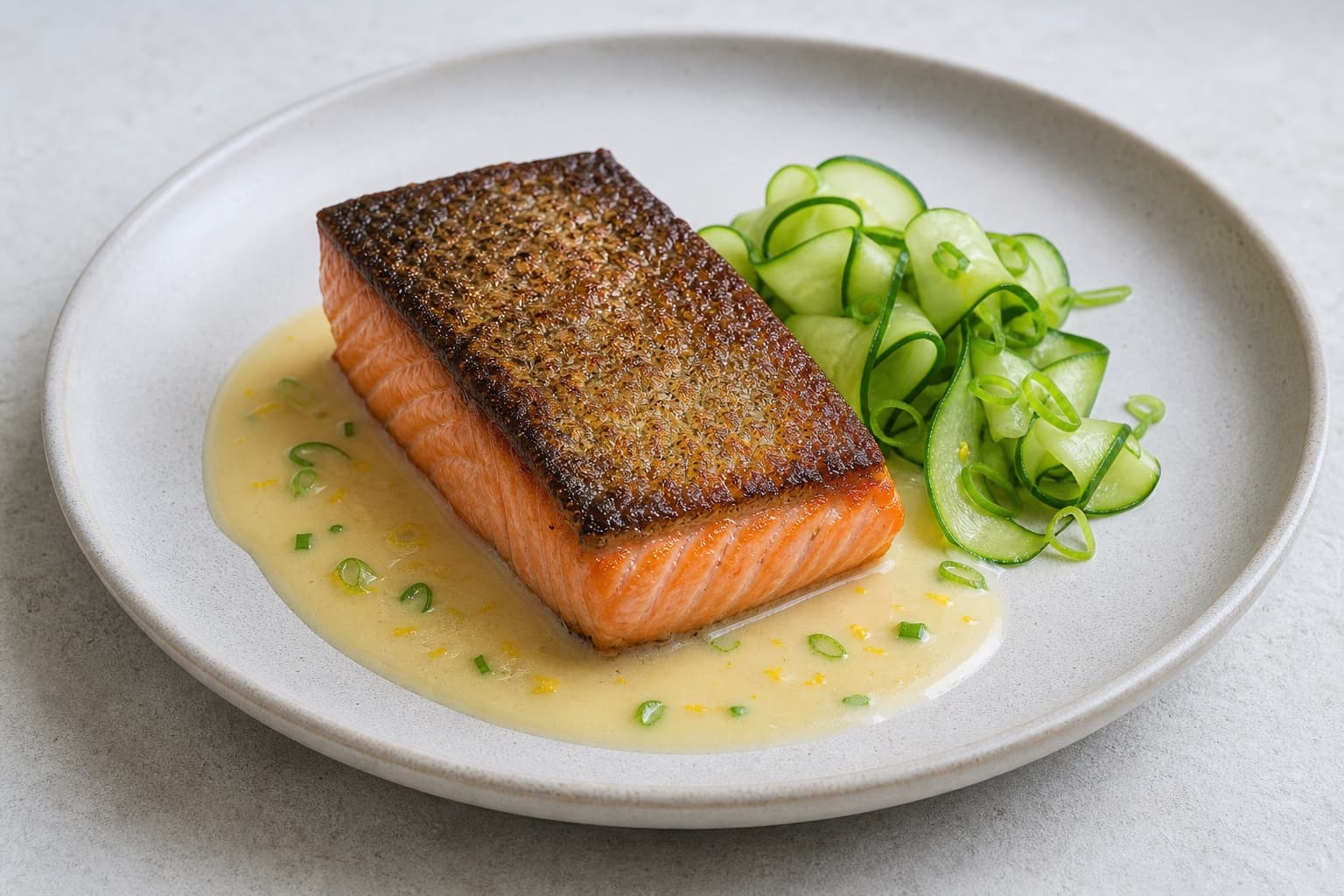
The skin is matte, taut, and slightly tacky rather than glossy or wet.
Open step 1JP · Modern Japanese-inspired
Dry-brined salmon is cooked almost entirely on its skin, then paired with warm white-miso lemon butter and sharply drained rice-vinegar cucumber. It is a transparent modern hybrid, not a traditional named washoku dish or an award claim.
Decision-point map
Scan the decision points now. Each full-size cooking frame appears once, beside the step where you need it.
The skin is matte, taut, and slightly tacky rather than glossy or wet.
Open step 1The sauce is pale, satin-glossy, and coats a spoon without oil beads.
Open step 3The centre reaches 63°C, flakes moist and opaque, releases little albumin, and skin stays crisp.
Check the final stepIngredients
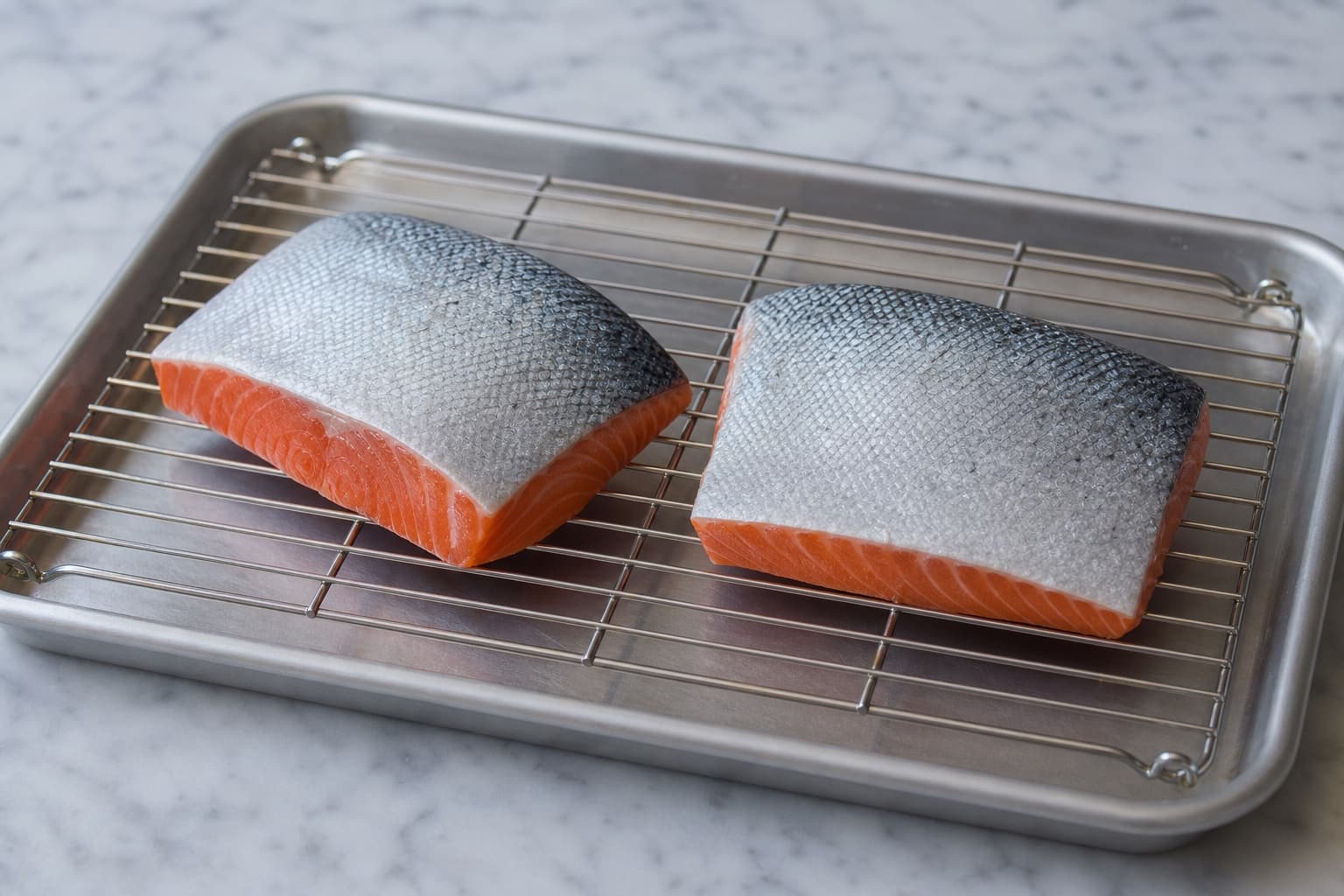
even fatty portions whose skin becomes the plate's main crisp texture
Generated reference - not verified cook evidence.
Note: Contains fish. Keep at 5°C or colder and separate raw-fish tools from the ready-to-eat cucumber.
Swap: skin-on ocean trout or king salmon of the same thickness
 Nearby fishmongers
 Search Coles
 Search WoolworthsFind an ALDIFind an IGASearch TozerbaSearch Asian PantryToko Nusantara
These links open searches, catalogues, or store locators. Check the exact form and local availability there.
Nearby fish marketsPasar Jaya networkSuper Indo locationsRanch Market outletsHypermart online Search Sayurbox
 Search Tokopedia
 Search ShopeeOpen GrabMart
These links open searches, catalogues, or store locators. Check the exact form and local availability there.
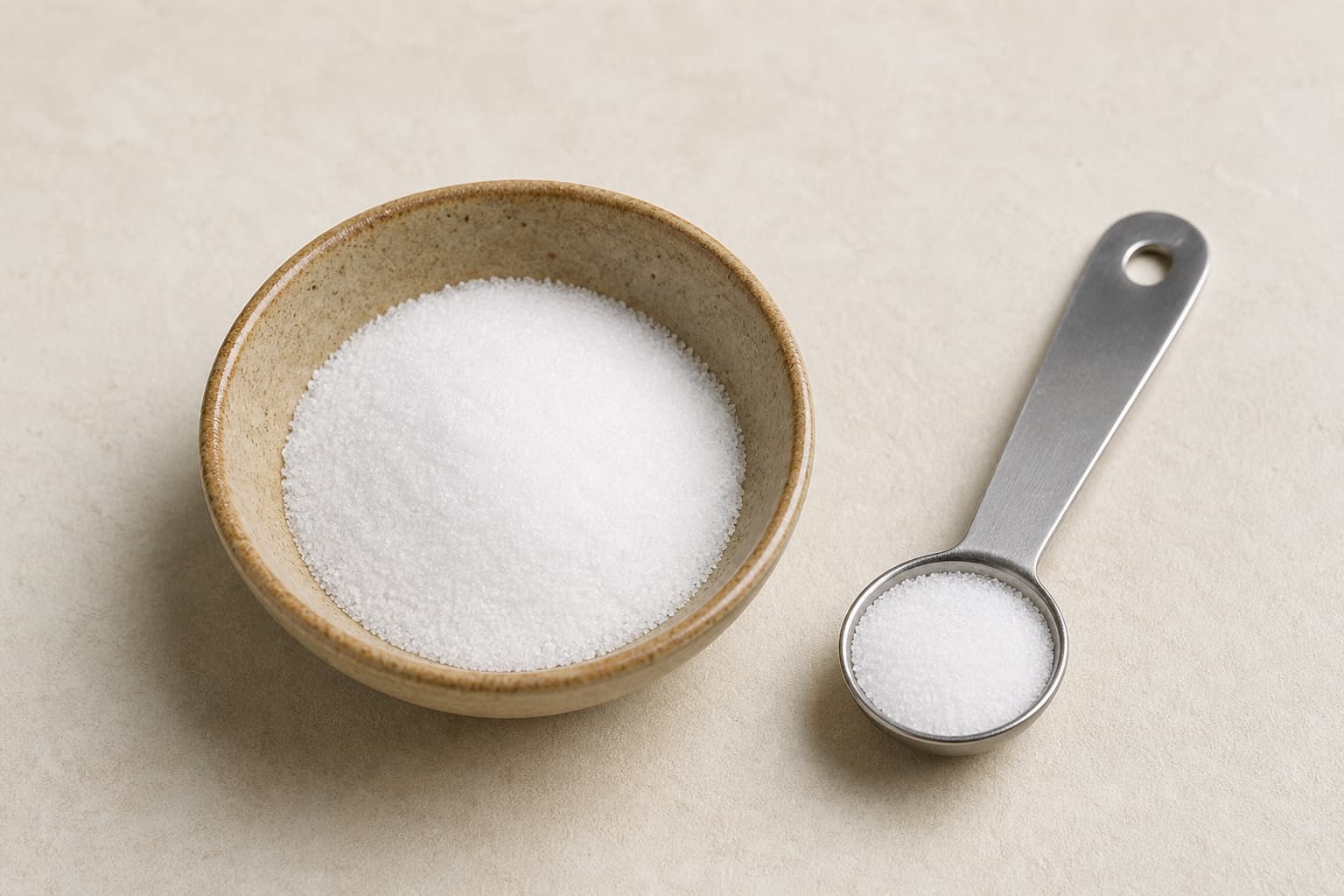
precise 1% dry brine that seasons while drawing surface moisture
Generated reference - not verified cook evidence.
Note: This amount is tied to 360 g fish; weigh 1% of the fish when scaling.
Nearby supermarketsSearch ColesSearch WoolworthsFind an ALDIFind an IGASearch TozerbaSearch Asian PantryToko NusantaraThese links open searches, catalogues, or store locators. Check the exact form and local availability there.
Nearby supermarketsSuper Indo locationsRanch Market outletsHypermart onlinePasar Jaya networkSearch SayurboxSearch TokopediaSearch ShopeeOpen GrabMartThese links open searches, catalogues, or store locators. Check the exact form and local availability there.
thin heat-transfer film beneath the salmon skin
Generated reference - not verified cook evidence.
Swap: canola, rice-bran, grapeseed, or vegetable oil
Nearby supermarketsSearch ColesSearch WoolworthsFind an ALDIFind an IGASearch TozerbaSearch Asian PantryToko NusantaraThese links open searches, catalogues, or store locators. Check the exact form and local availability there.
Nearby supermarketsSuper Indo locationsRanch Market outletsHypermart onlinePasar Jaya networkSearch SayurboxSearch TokopediaSearch ShopeeOpen GrabMartThese links open searches, catalogues, or store locators. Check the exact form and local availability there.
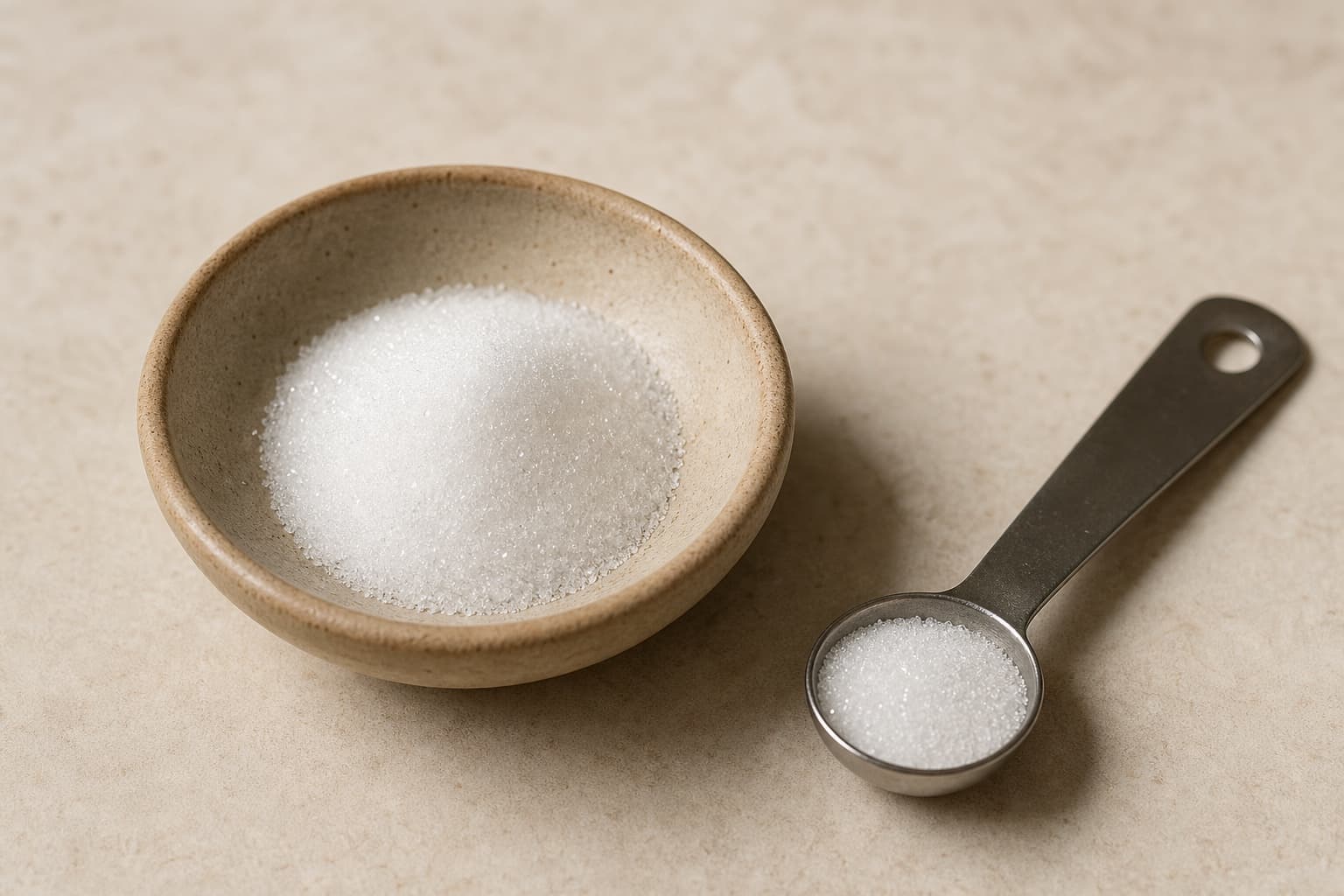
rounds the rice vinegar without making a sweet pickle
Generated reference - not verified cook evidence.
Nearby supermarketsSearch ColesSearch WoolworthsFind an ALDIFind an IGASearch TozerbaSearch Asian PantryToko NusantaraThese links open searches, catalogues, or store locators. Check the exact form and local availability there.
Nearby supermarketsSuper Indo locationsRanch Market outletsHypermart onlinePasar Jaya networkSearch SayurboxSearch TokopediaSearch ShopeeOpen GrabMartThese links open searches, catalogues, or store locators. Check the exact form and local availability there.
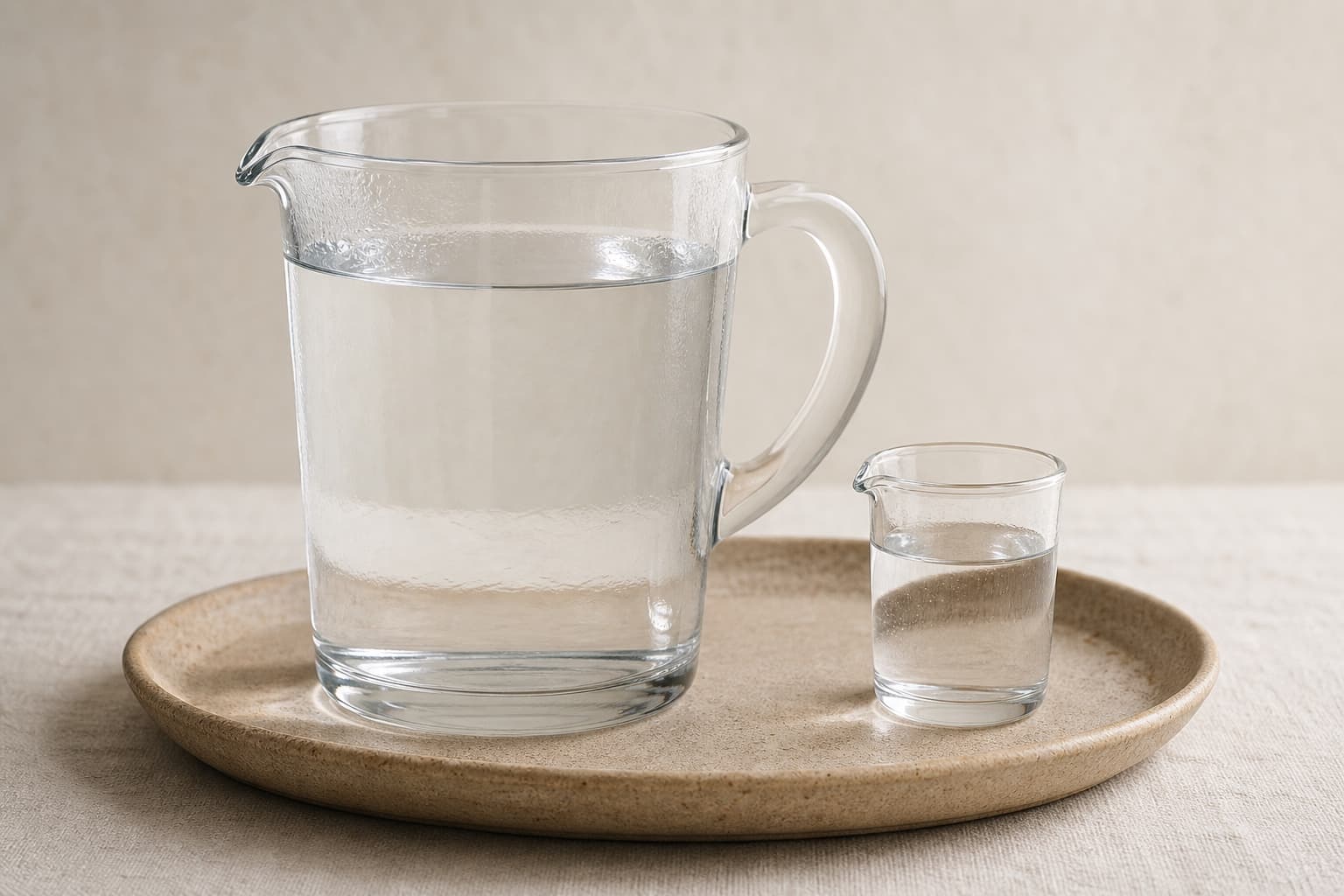
starts and, if necessary, rescues the butter emulsion
Generated reference - not verified cook evidence.
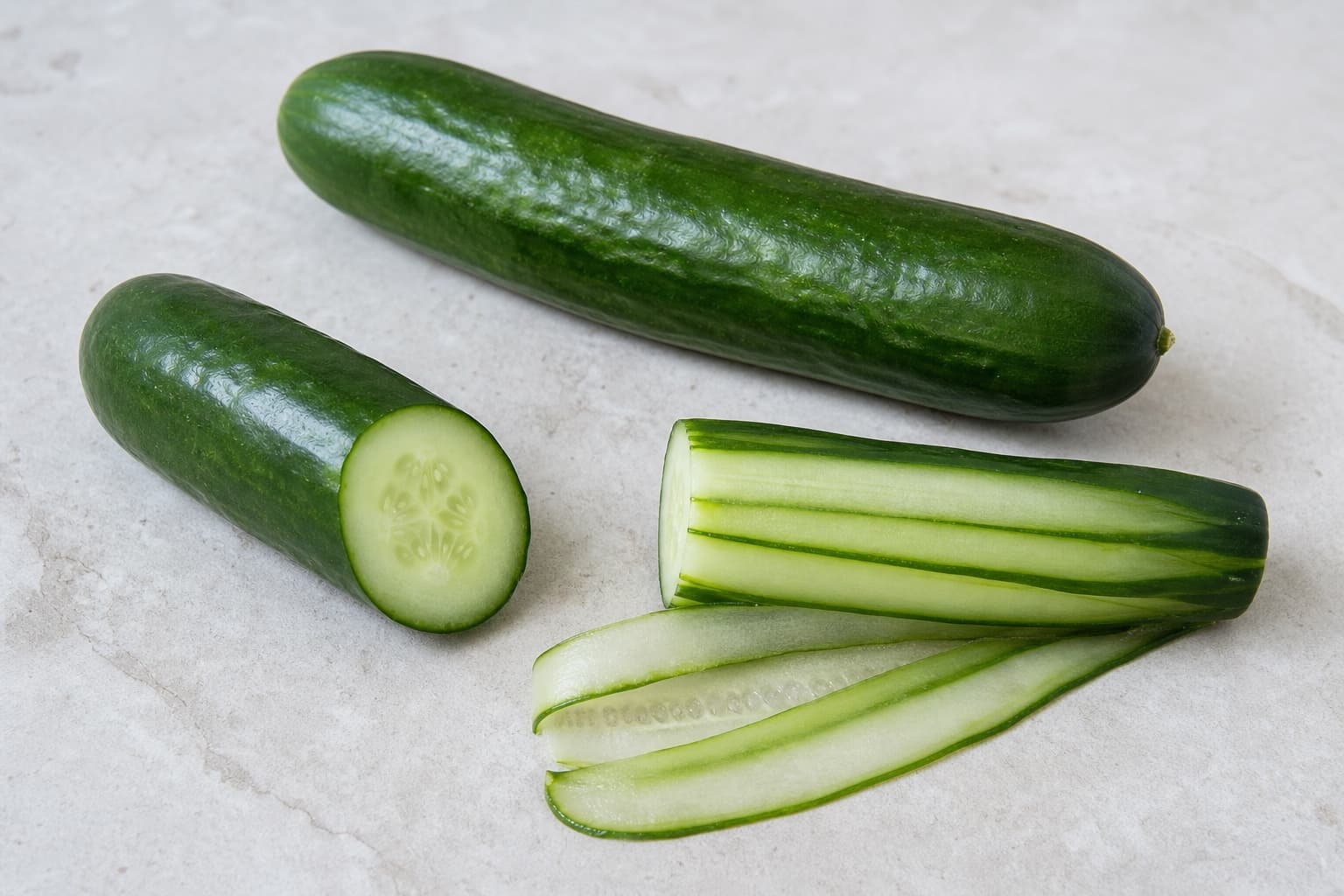
cold crisp acidity beside rich fish and butter
Generated reference - not verified cook evidence.
Swap: Persian cucumber; seed a very watery mature cucumber
Nearby produce marketsSearch ColesSearch WoolworthsFind an ALDIFind an IGASearch TozerbaSearch Asian PantryToko NusantaraThese links open searches, catalogues, or store locators. Check the exact form and local availability there.
Nearby produce marketsPasar Jaya networkSuper Indo locationsRanch Market outletsHypermart onlineSearch SayurboxSearch TokopediaSearch ShopeeOpen GrabMartThese links open searches, catalogues, or store locators. Check the exact form and local availability there.
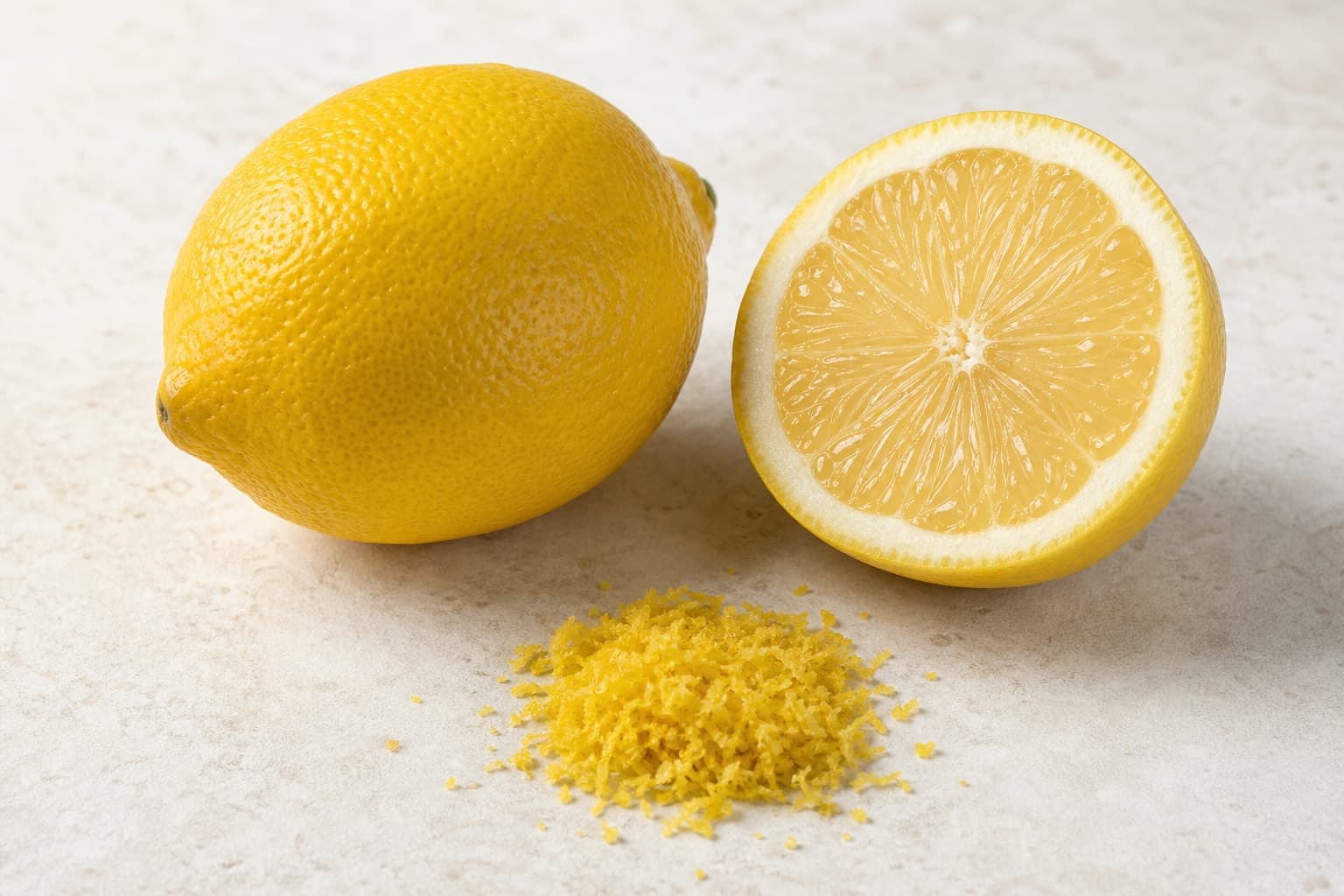
zest supplies aroma and measured juice cuts the butter
Generated reference - not verified cook evidence.
Nearby produce marketsSearch ColesSearch WoolworthsFind an ALDIFind an IGASearch TozerbaSearch Asian PantryToko NusantaraThese links open searches, catalogues, or store locators. Check the exact form and local availability there.
Nearby produce marketsPasar Jaya networkSuper Indo locationsRanch Market outletsHypermart onlineSearch SayurboxSearch TokopediaSearch ShopeeOpen GrabMartThese links open searches, catalogues, or store locators. Check the exact form and local availability there.
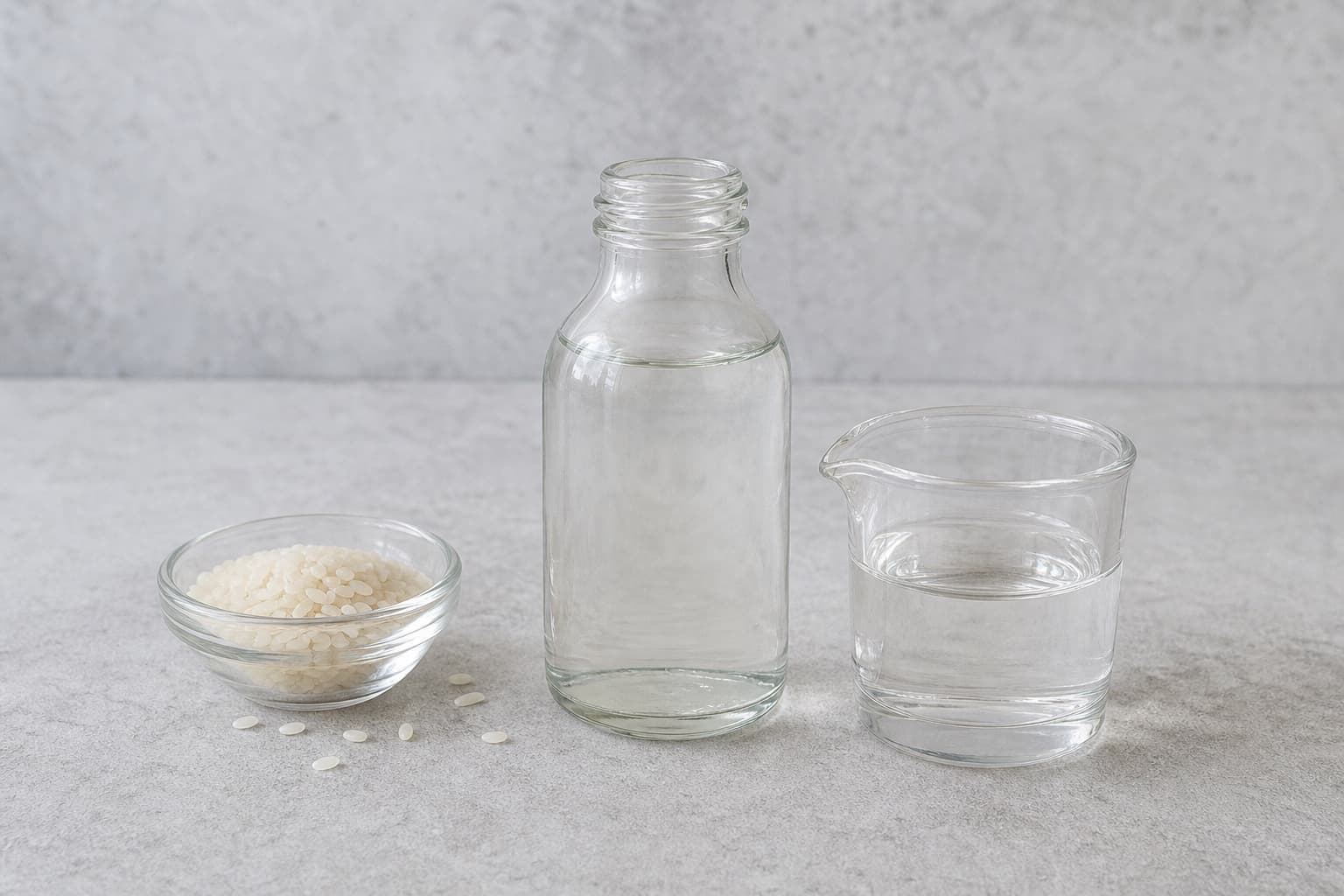
clean acidity for the quick cucumber dressing
Generated reference - not verified cook evidence.
Note: Seasoned sushi vinegar already contains salt and sugar.
Swap: 12 ml apple-cider vinegar plus 3 ml water
Nearby specialist grocersMr Dad CBD guideGuideLaguna QV route leadGuideSearch TozerbaSearch Asian PantryToko NusantaraSearch ColesSearch WoolworthsFind an ALDIFind an IGAThese links open searches, catalogues, or store locators. Check the exact form and local availability there.
Nearby specialist shopsSearch SayurboxSearch TokopediaSearch ShopeeOpen GrabMartSuper Indo locationsRanch Market outletsHypermart onlinePasar Jaya networkThese links open searches, catalogues, or store locators. Check the exact form and local availability there.
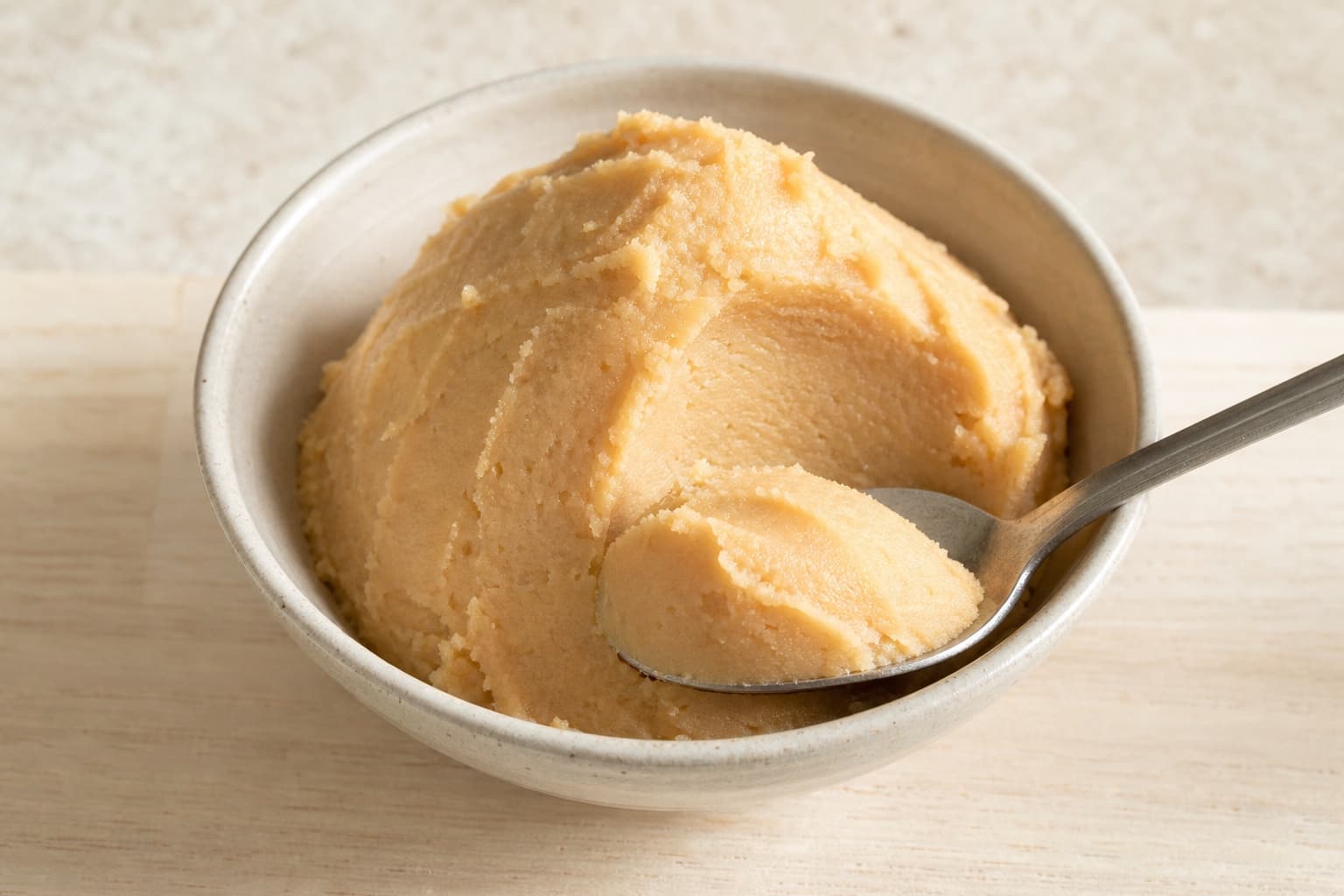
mellow fermented savour and body without darkening the pale sauce
Generated reference - not verified cook evidence.
Note: Usually contains soy and some products contain barley or other gluten sources.
Swap: verified chickpea miso for a soy-free route
Nearby specialist grocersMr Dad CBD guideGuideLaguna QV route leadGuideKT Mart route leadGuideTokyo Hometown guideGuideSearch TozerbaSearch Asian PantryToko NusantaraSearch ColesSearch WoolworthsFind an ALDIFind an IGAThese links open searches, catalogues, or store locators. Check the exact form and local availability there.
Nearby specialist shopsSearch SayurboxSearch TokopediaSearch ShopeeOpen GrabMartSuper Indo locationsRanch Market outletsHypermart onlinePasar Jaya networkThese links open searches, catalogues, or store locators. Check the exact form and local availability there.
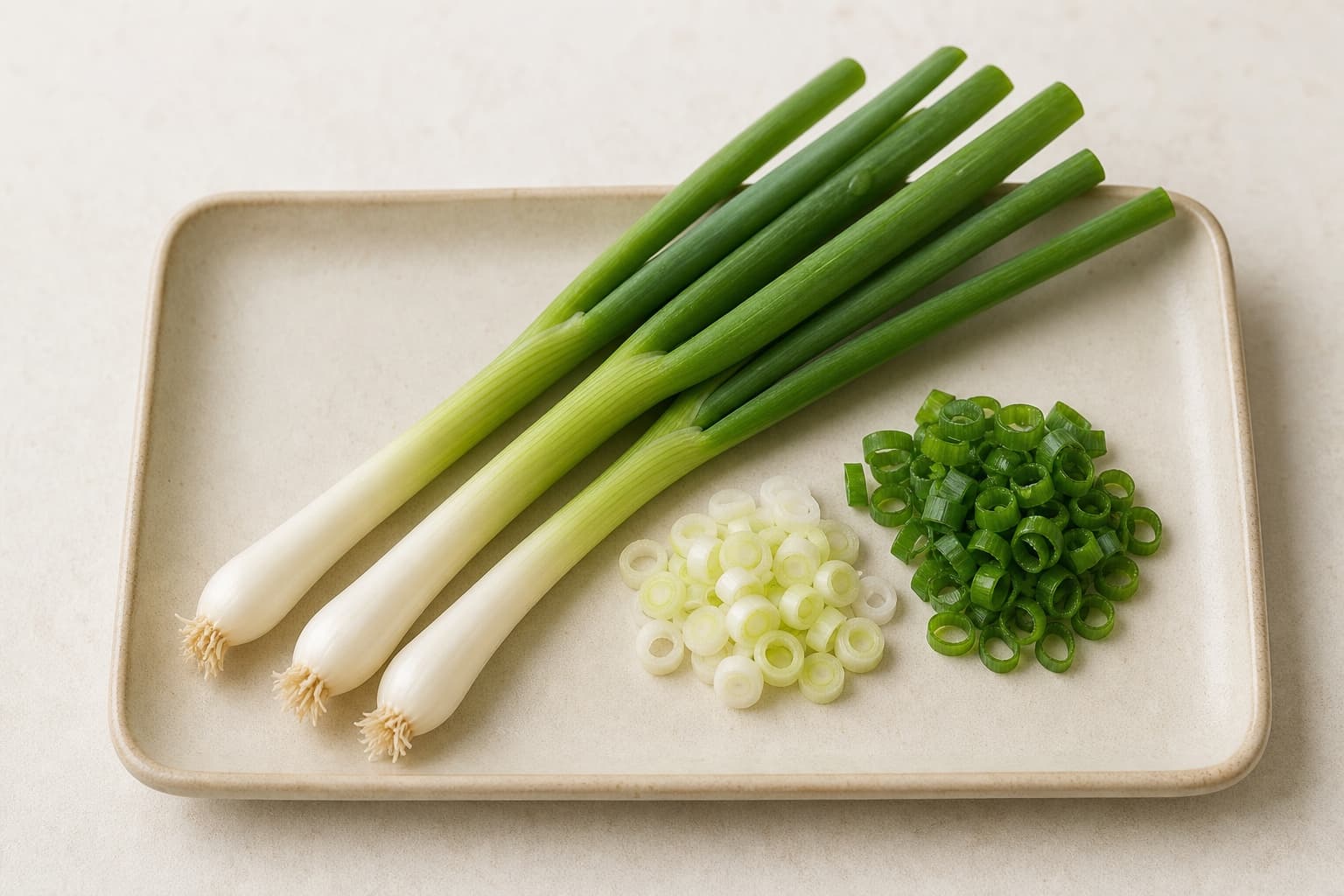
mild allium lift in the cucumber and fresh finish
Generated reference - not verified cook evidence.
Nearby produce marketsSearch ColesSearch WoolworthsFind an ALDIFind an IGASearch TozerbaSearch Asian PantryToko NusantaraThese links open searches, catalogues, or store locators. Check the exact form and local availability there.
Nearby produce marketsPasar Jaya networkSuper Indo locationsRanch Market outletsHypermart onlineSearch SayurboxSearch TokopediaSearch ShopeeOpen GrabMartThese links open searches, catalogues, or store locators. Check the exact form and local availability there.
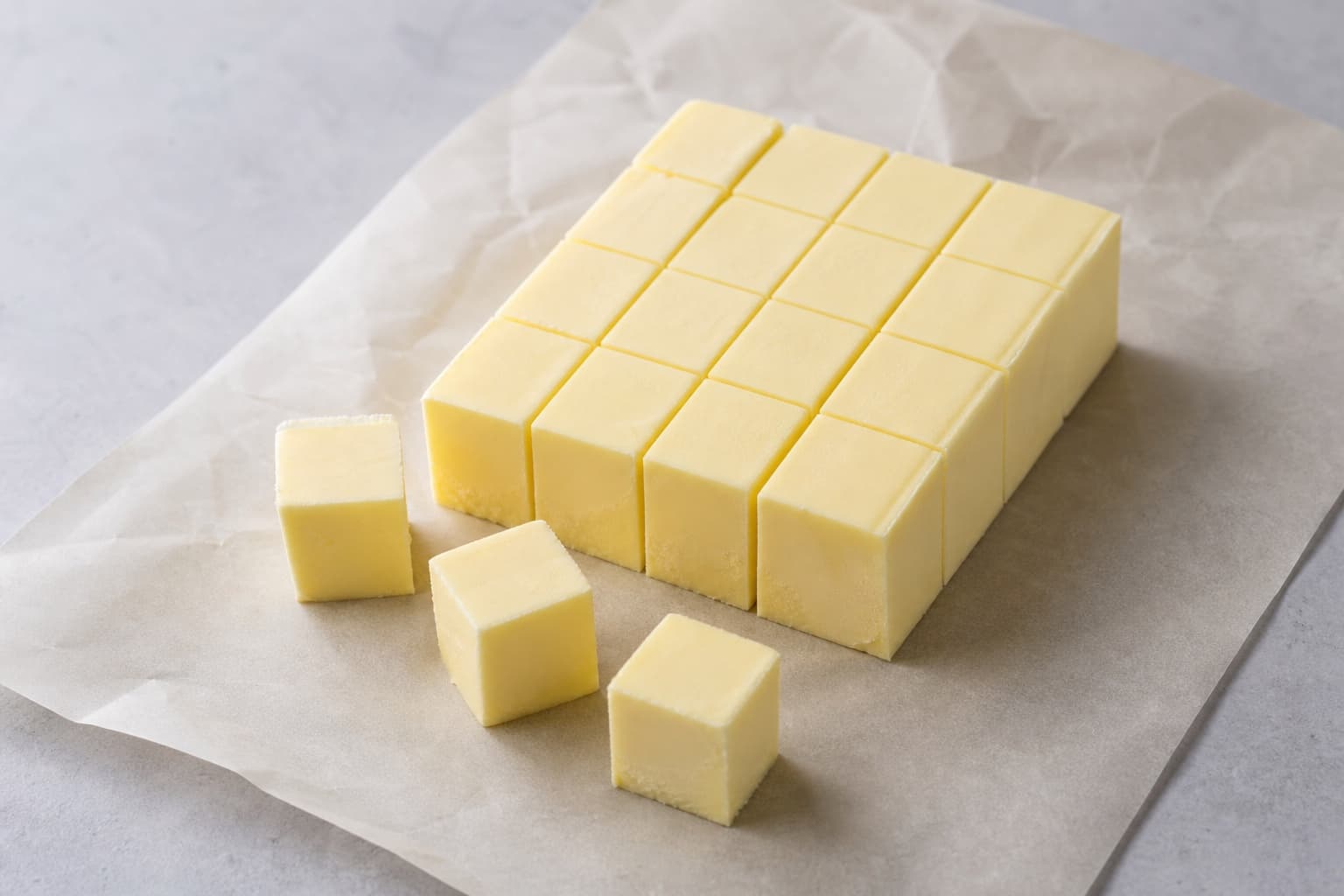
forms the warm satin emulsion around miso and lemon
Generated reference - not verified cook evidence.
Note: Contains milk unless a verified dairy-free substitute is used.
Swap: firm dairy-free block butter, not a soft tub spread
Nearby supermarketsSearch ColesSearch WoolworthsFind an ALDIFind an IGASearch TozerbaSearch Asian PantryToko NusantaraThese links open searches, catalogues, or store locators. Check the exact form and local availability there.
Nearby supermarketsSuper Indo locationsRanch Market outletsHypermart onlinePasar Jaya networkSearch SayurboxSearch TokopediaSearch ShopeeOpen GrabMartThese links open searches, catalogues, or store locators. Check the exact form and local availability there.
Calculated estimate · per serving
1 of 2 plated servings: one 180 g raw-weight salmon portion, half the miso butter and cucumber; no rice or other side included
Calculated from the authored edible ingredient weights using representative AFCD Release 3 and USDA FoodData Central profiles, then divided by the recipe yield. Energy follows the FSANZ ingredient-contribution method. Optional serving accompaniments are excluded. The calculation uses a representative raw Atlantic salmon profile, counts all 60 g butter sauce and dry-brine salt, and assumes half the 10 ml skillet oil remains with the finished fish.
Calculated estimate only, not a laboratory result or personalised dietary advice. Actual values vary with brands, produce, meat trim, substitutions, final serving size, and how much cooking or rendered oil is left in the pan or skimmed. Check packaged labels for allergens and sodium; consult an accredited practising dietitian or clinician for medical dietary needs. Salmon species and farmed-versus-wild fat content vary substantially; blotted brine and oil left in the skillet can make the finished sodium, fat, and energy lower.
Reference data: Australian Food Composition Database · FSANZ calculation method · USDA FoodData Central · calculated 2026-07-14
Step-by-step method
Read the action and cue together. Move on when the food matches the cue.
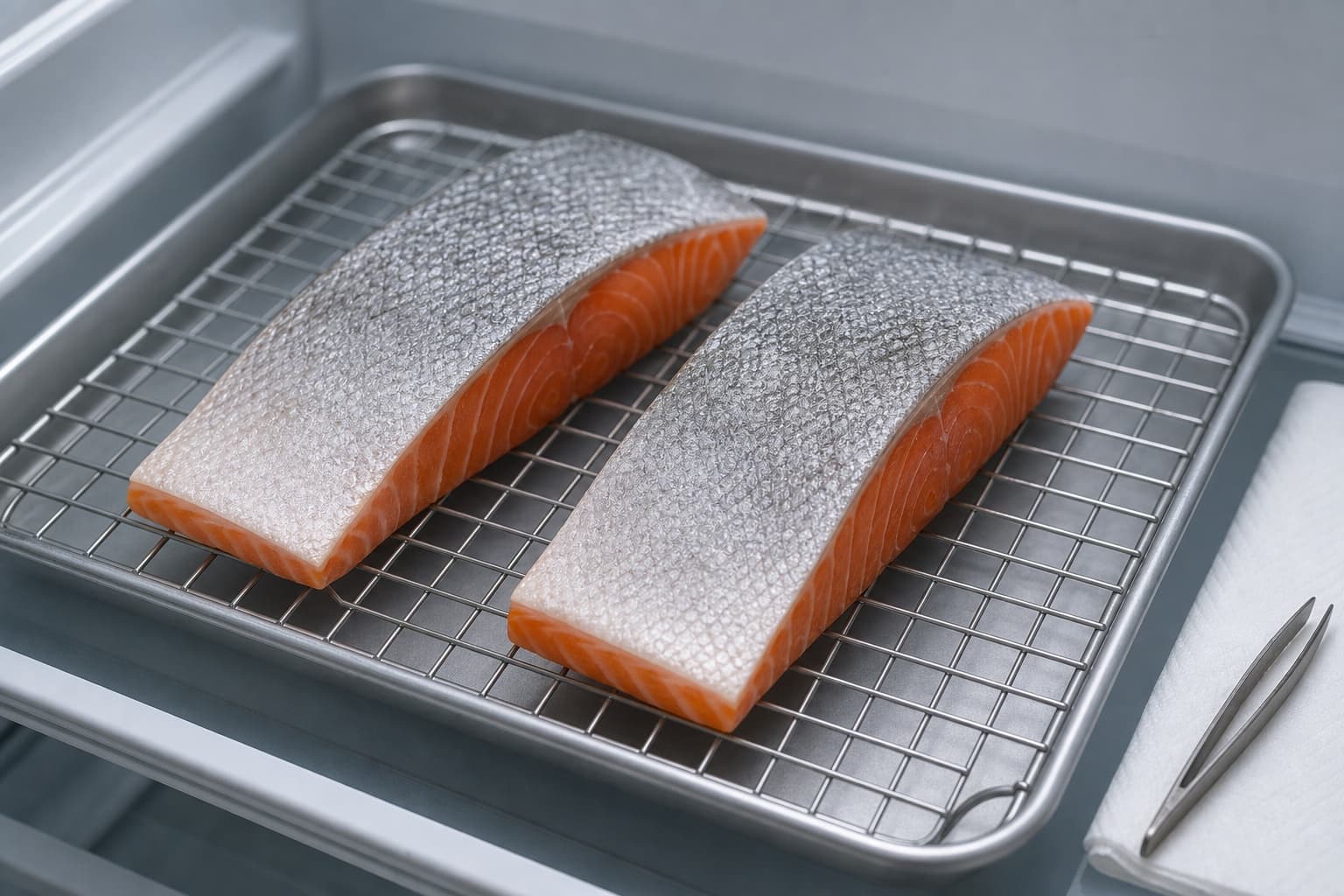
Check salmon for scales and pull every pin bone. Pat dry, distribute the measured salt over flesh and skin, and refrigerate uncovered skin-up on a rack for 30 minutes. Keep raw-fish tools away from cucumber equipment. Blot all new moisture completely dry at the end.
Common mistake: Skipping the second blot leaves enough moisture to steam; brining far beyond 1 hour makes small portions firm.
Recovery: Spread the food out, raise heat only after moisture drops, and hold back extra sauce until the pan is frying again.
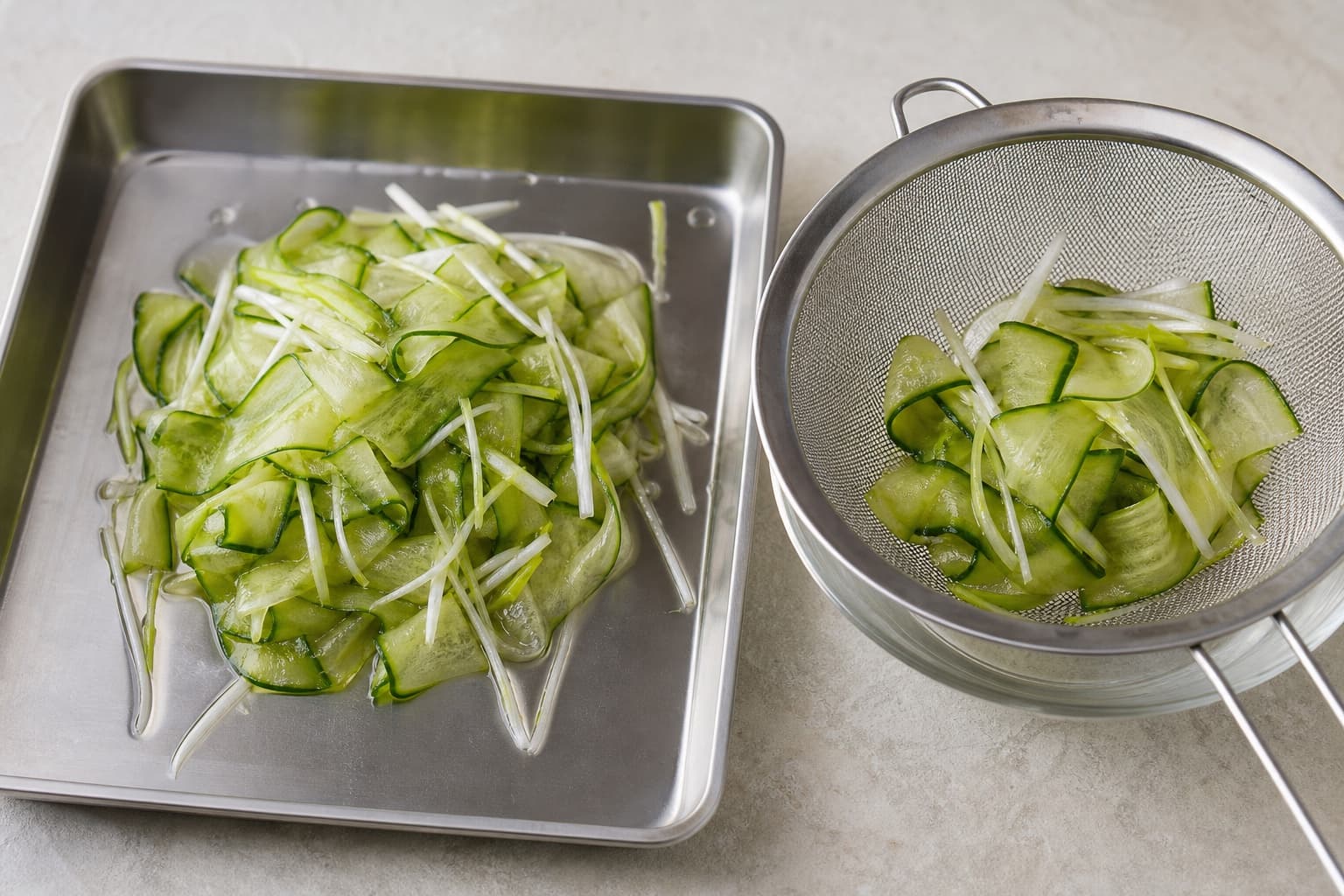
Shave cucumber into 2 mm ribbons. Thinly slice scallion, reserving the greenest slices. Stir rice vinegar and sugar until clear, toss with cucumber and scallion whites, and stand 10 minutes. Drain in a sieve and blot lightly so no dressing pools.
Common mistake: Wet cucumber dilutes the sauce and sends liquid under the salmon skin.
Recovery: Spread the food out, raise heat only after moisture drops, and hold back extra sauce until the pan is frying again.
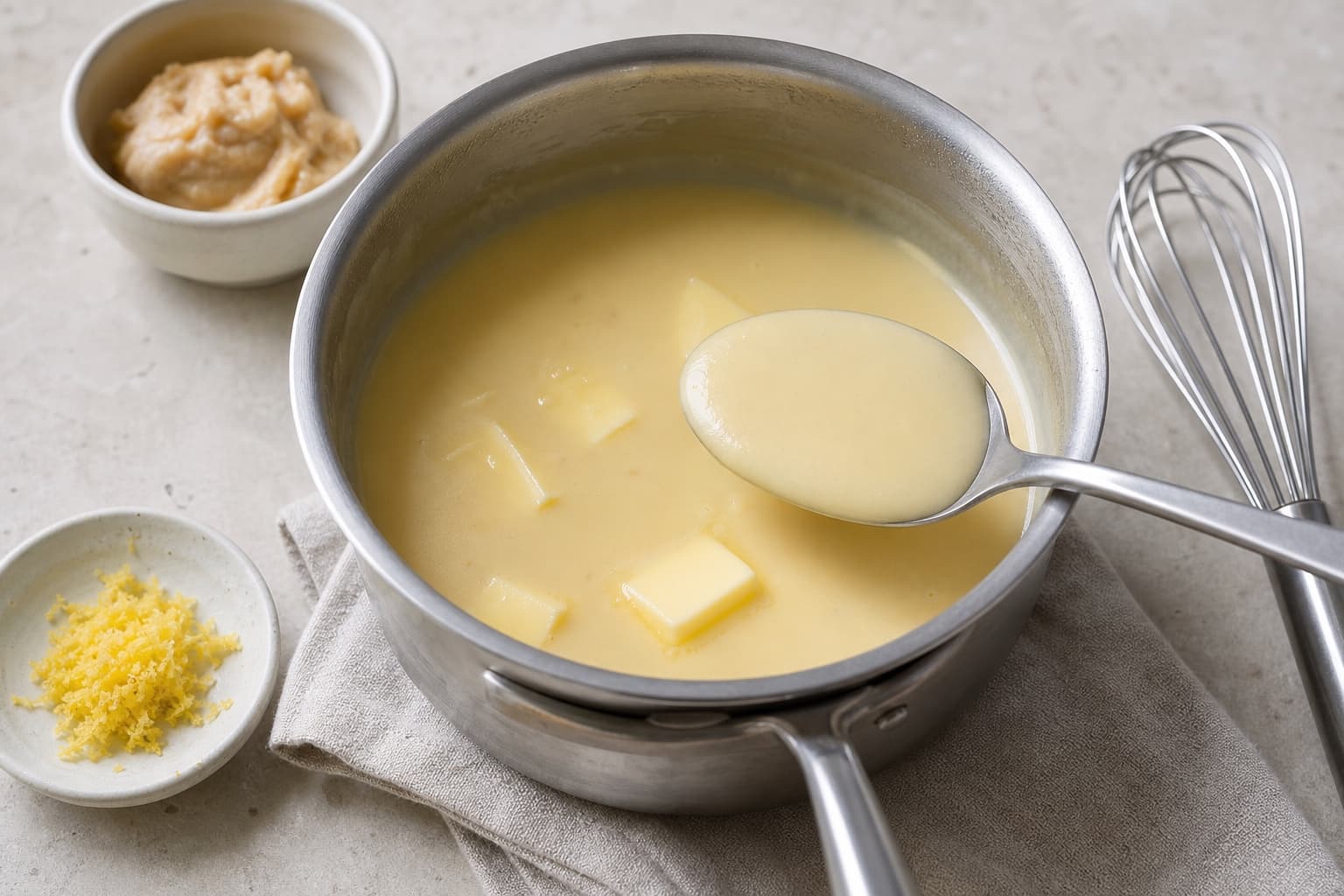
Heat 10 ml of the measured water in a small saucepan only until first steam. Use the lowest heat and whisk in cold butter four or five cubes at a time, lifting off heat whenever oily. Remove from heat and whisk in white miso, lemon zest, and juice. Keep just warm and never simmer. Reserve 5 ml cold water for rescue.
Common mistake: Boiling or adding all butter at once splits it; off heat, whisk in reserved water drop by drop.
Recovery: Lower the heat immediately, skim or stir gently, and continue at a small simmer until the surface calms.
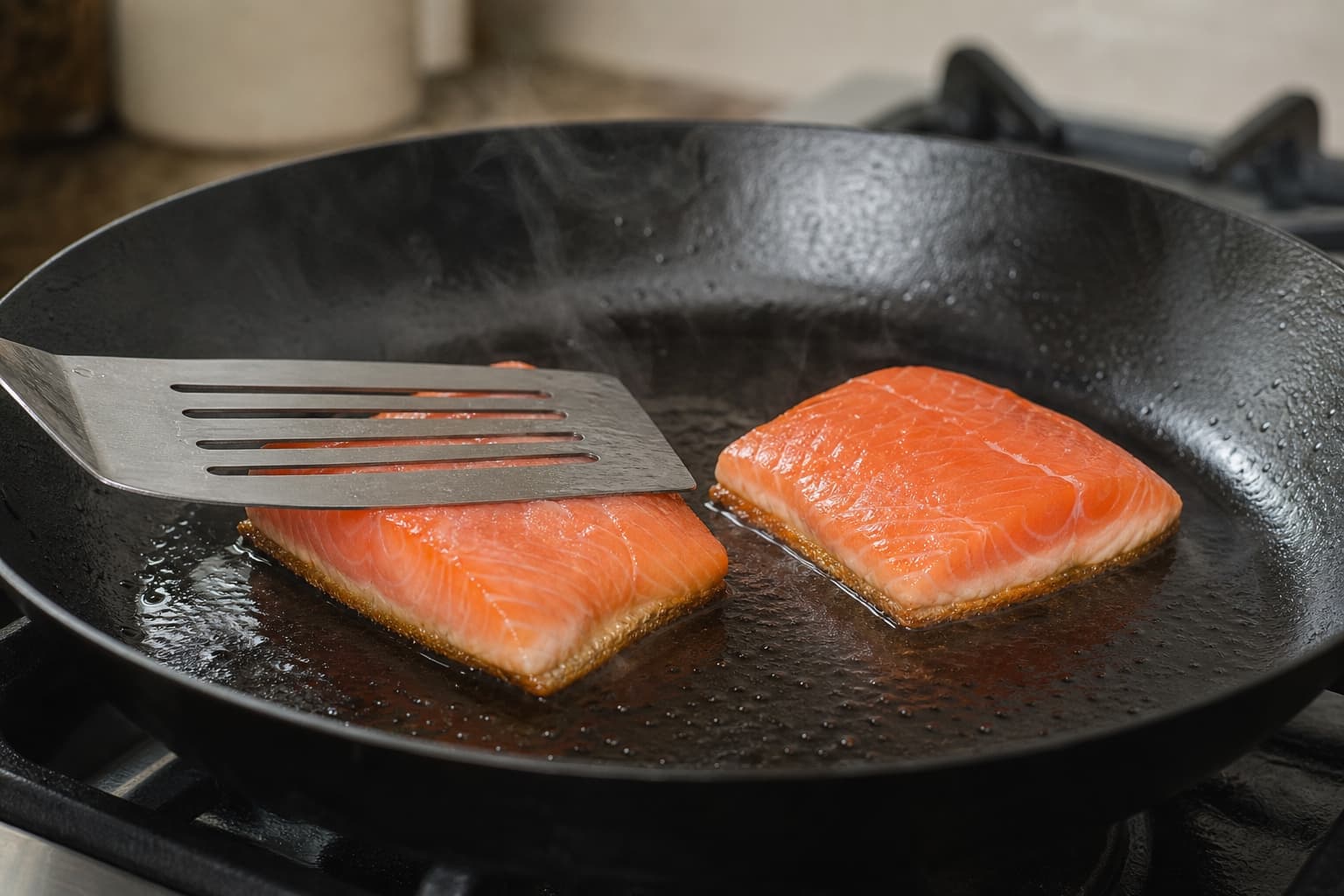
Heat the dry heavy skillet over medium-high for about 3 minutes. Blot salmon again. Add neutral oil; it should shimmer, not smoke. Lower fillets skin-side down away from you and press firmly with a fish slice for 30-45 seconds until flat. Reduce to medium and cook undisturbed for another 6-8 minutes.
Common mistake: Repeated lifting tears the crust; fierce heat blackens the edge before the centre warms.
Recovery: Pause before the next step, compare the cue, then correct heat, moisture, or seasoning while the dish is still flexible.
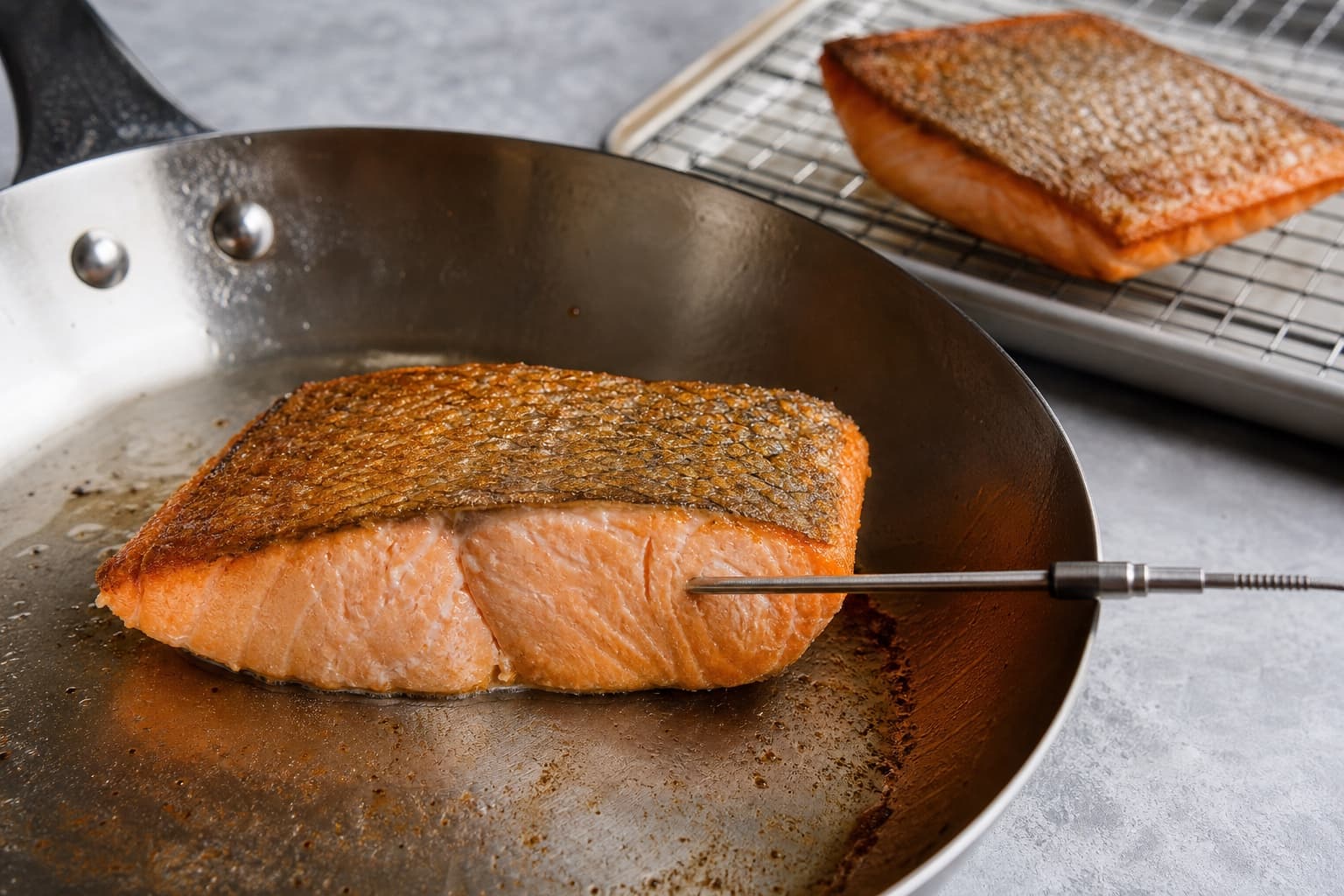
When skin releases, flip once and lower heat. Cook flesh-side for 1-3 minutes, probing horizontally into the thickest centre. Transfer skin-up to a rack at 60-61°C and rest 3 minutes. Verify carryover reaches 63°C; if not, return flesh-side down for 20-second intervals and recheck.
Common mistake: Removing both portions by the same clock time ignores thickness and pan position.
Recovery: Pause before the next step, compare the cue, then correct heat, moisture, or seasoning while the dish is still flexible.
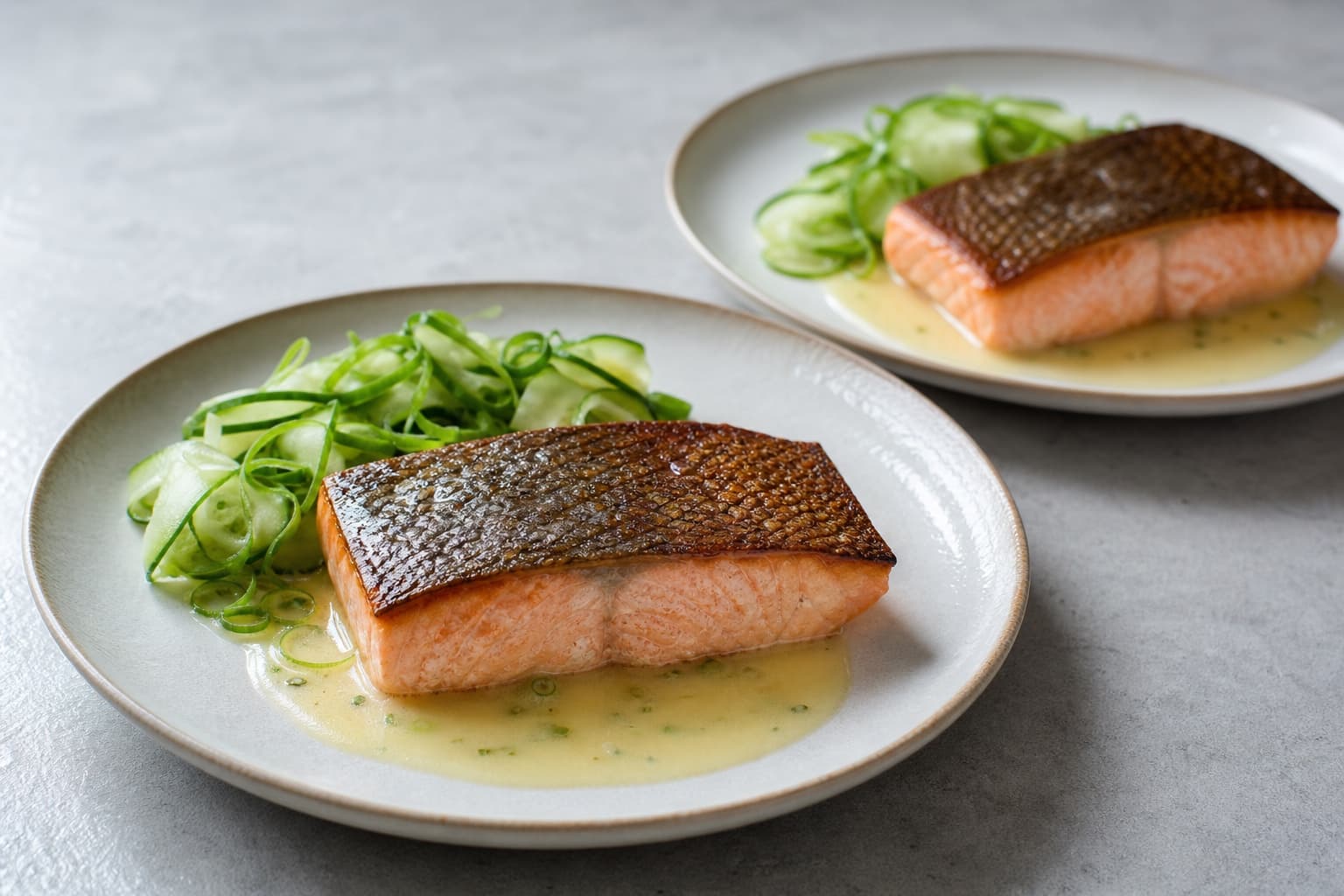
Whisk sauce once and warm only until fluid. Drain cucumber again. Spoon a shallow sauce pool on each warm plate, place salmon so only flesh meets sauce and skin faces up, coil cucumber alongside, and scatter reserved scallion greens. Serve now. Refrigerate within 2 hours and use within 2 days; reheat once to 74°C, accepting softer skin.
Common mistake: Covering fish, skin against sauce, or holding the plate lets trapped steam undo the crust.
Recovery: Spread the food out, raise heat only after moisture drops, and hold back extra sauce until the pan is frying again.
Fix problems
The active method already includes its most likely mistake and recovery. Open the reference library when your question falls outside the current step.
No. It is an original, source-grounded synthesis of documented restaurant techniques. It is described as fine-dining-inspired, never as Michelin-awarded or as a chef's exact signature dish.
Use even centre cuts, remove every moisture bead, preheat a suitable heavy pan, press for the first 30-45 seconds, then leave it until the crust releases naturally.
Restaurant texture sources often document lower temperatures, but public food-safety guidance sets 63°C for fish. This recipe uses that endpoint, especially for vulnerable diners.
Take it off heat and whisk in reserved cold water drop by drop. If still oily, start with 5 ml fresh warm water in a clean pan and gradually whisk the broken sauce into it.
Yes. Thaw overnight in the refrigerator, unwrap, and dry exceptionally well. Measure components ahead, but dress cucumber and emulsify butter close to cooking.
Build evenly crisp skin, stop the centre at a verified safe-but-succulent endpoint, and keep the butter sauce glossy instead of split. Look for pale satin sauce, coiled cucumber, and salmon skin entirely dry: Glossy sauce sits beneath the flesh, drained cucumber sits alongside, and the crisp skin remains exposed.
Skipping the second blot leaves enough moisture to steam; brining far beyond 1 hour makes small portions firm. Spread the food out, raise heat only after moisture drops, and hold back extra sauce until the pan is frying again.
Scale the measured ingredients with the serving count, then scale the vessel or work in batches. Keep the same visual finish - pale satin sauce, coiled cucumber, and salmon skin entirely dry - rather than forcing the original timer.
skin-on centre-cut salmon portions: skin-on ocean trout or king salmon of the same thickness; neutral high-heat oil: canola, rice-bran, grapeseed, or vegetable oil; Lebanese or Japanese cucumber: Persian cucumber; seed a very watery mature cucumber; unseasoned rice vinegar: 12 ml apple-cider vinegar plus 3 ml water
skin-on centre-cut salmon portions: Contains fish. Keep at 5°C or colder and separate raw-fish tools from the ready-to-eat cucumber.; fine sea salt: This amount is tied to 360 g fish; weigh 1% of the fish when scaling.; unseasoned rice vinegar: Seasoned sushi vinegar already contains salt and sugar.; cold unsalted butter: Contains milk unless a verified dairy-free substitute is used.
Melbourne and Jakarta
Current links help you search by the right ingredient name; they do not confirm a product, price, or stock level.
Use a high-turnover fishmonger and request two scaled, pin-boned, skin-on centre cuts of equal thickness. Queen Victoria Market's official seafood directory is a practical CBD starting point, not a stock promise.
skin-on centre-cut salmon portions: skin-on ocean trout or king salmon of the same thickness.
skin-on centre-cut salmon portions: Contains fish. Keep at 5°C or colder and separate raw-fish tools from the ready-to-eat cucumber.
Nearby fishmongersSearch ColesSearch WoolworthsFind an ALDIFind an IGASearch TozerbaSearch Asian PantryToko NusantaraThese links open searches, catalogues, or store locators. Check the exact form and local availability there.
Use a high-turnover chilled or frozen seafood counter and ask for two even skin-on centre cuts. Confirm origin, use-by date, package temperature, and current stock.
skin-on centre-cut salmon portions: skin-on ocean trout or king salmon of the same thickness.
skin-on centre-cut salmon portions: Contains fish. Keep at 5°C or colder and separate raw-fish tools from the ready-to-eat cucumber.
Nearby fish marketsPasar Jaya networkSuper Indo locationsRanch Market outletsHypermart onlineSearch SayurboxSearch TokopediaSearch ShopeeOpen GrabMartThese links open searches, catalogues, or store locators. Check the exact form and local availability there.
Flavour foundation
A measured 1% dry brine firms and dehydrates the skin; unilateral cooking gives it time to crisp before the flesh is briefly finished. Cold butter is whisked into a small water phase away from boiling heat, and sauce stays under the flesh so the crust remains dry.
Taste profile
White miso and rice vinegar establish a Japanese pantry direction, while unilateral pan cooking and butter emulsion are international restaurant techniques. This is a transparent contemporary hybrid, not a traditional named Japanese dish.
Cook plan
Versions
Diet & allergens
Dietary notes: pescatarian, nut-free, gluten-free when labelled.
Contains or may contain: fish, milk, soy, possible gluten depending on miso.
Check packaged-ingredient labels and cross-contamination advice for the brands you use.
Budget
Planning estimate only - not live or locally verified pricing
What belongs where
The fish, warm butter emulsion, and cold cucumber are made independently. They touch only at plating so the skin stays dry and each texture remains legible.
Storage notes are conservative home-kitchen guidance. Chill perishable food within 2 hours, keep it at 5°C or colder, and follow local food-safety and package directions when they are stricter.
Sources & evidence
Sources support the specific technique or safety point stated below. Generated reference imagery is editorial guidance, not proof that this recipe has passed an independent cook test.
Cross-checks dry skin, firm initial contact, predominantly skin-side cooking, a brief flesh-side finish, and protecting the finished crust from wet plating.
Boundary: Restaurant texture targets may be lower than public food-safety endpoints. Bumbu Lens independently specifies a 63°C verified centre rather than copying a chef doneness preference.Grounds miso as a Japanese fermented soybean seasoning while leaving this butter-emulsion pairing explicitly contemporary and hybrid.
Boundary: This official ingredient context does not make miso-lemon butter a traditional named Japanese sauce.Applies the public 63°C / 145°F endpoint for fish and requires a horizontal centre probe rather than relying on opacity or flakes alone.
Boundary: Portion thickness and pan position change carryover. Return under-temperature fish to the pan in short measured intervals and recheck.Supports explicit fish, milk, and soy disclosure and checking the exact miso and vinegar label for other declared allergens.
Boundary: Ingredient-category guidance cannot prove a specific package is gluten-free or suitable for an individual allergy.Recorded as a local editorial or generated visual cue asset, not an independent external source.
Boundary: A local or generated asset is visual guidance, not evidence of authenticity, ingredient quantities, timing, safety, or method accuracy.Next cooks
Recipes here share ingredients, bumbu logic, region, spice level, or weeknight patterns so the next cook reuses what you just learned.
 Bali-inspired · IntermediateCrispy-Skin Salmon Sambal MatahCrisp the skin without drying the fish, then keep bright sambal beside - not over - the crust.
 Britain / modern restaurant tradition · PatientBeef WellingtonSynchronise a crisp pastry shell with safely rested, evenly pink beef and thin, distinct moisture-barrier layers.
 Japan / yōshoku · IntermediateJapanese Pork TonkatsuKeep a thick pork chop juicy and safely cooked inside an airy panko shell that stays attached and audibly crisp.
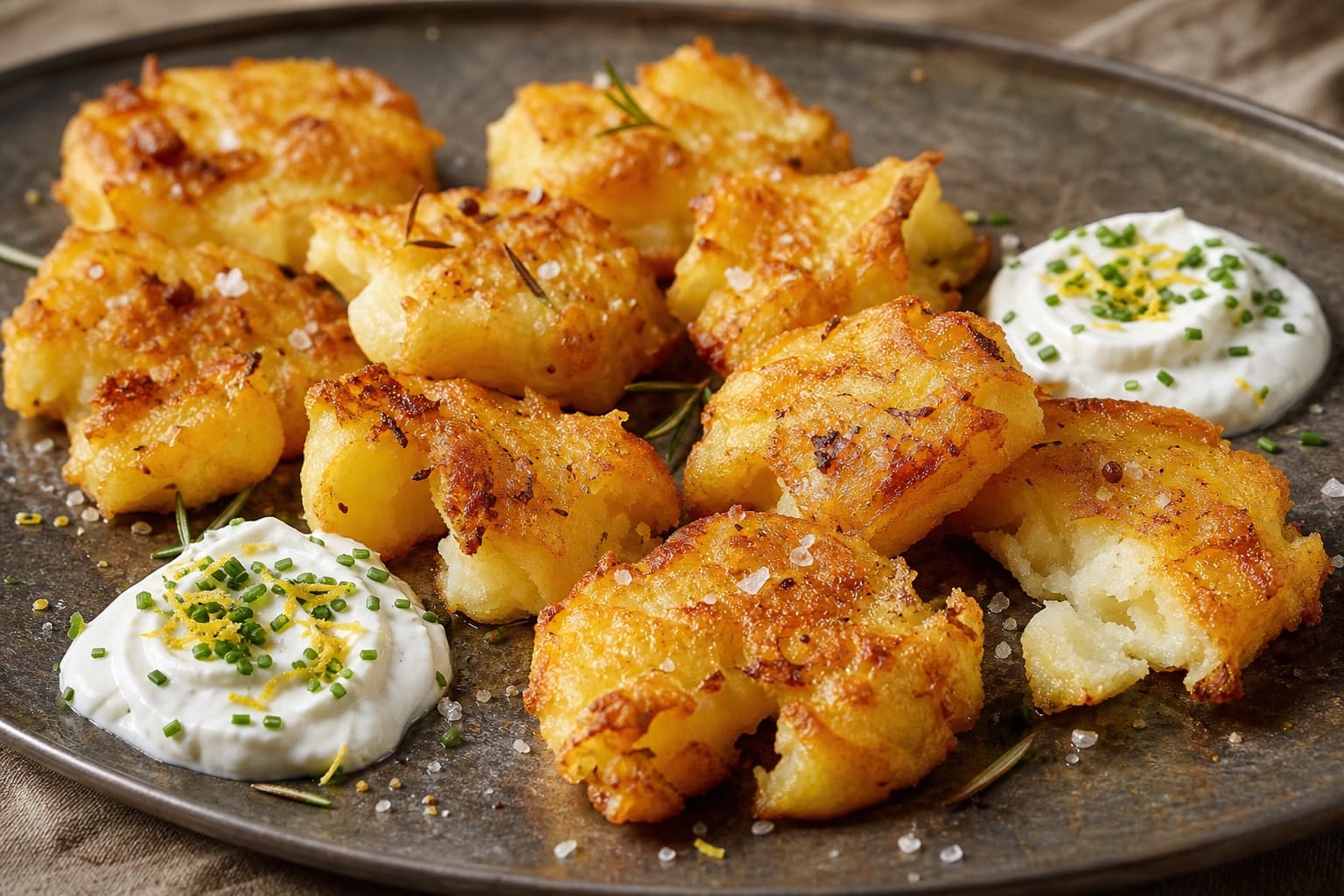 Contemporary British technique · IntermediateUltra-Crispy Smashed PotatoesBuild a brittle, craggy golden shell around a genuinely fluffy centre without needing a deep fryer.
 Japan · IntermediateChawanmushiSet a glossy, spoonable custard with no bubbles, stringy egg, or honeycomb holes.
 Modern Indonesian · PatientIga Sapi Goreng MaduMake ribs fork-tender yet intact, then glaze them glossy without scorching the honey.