Recipe 16 / 19
JP · Japan / yōshoku
Japanese Pork Tonkatsu
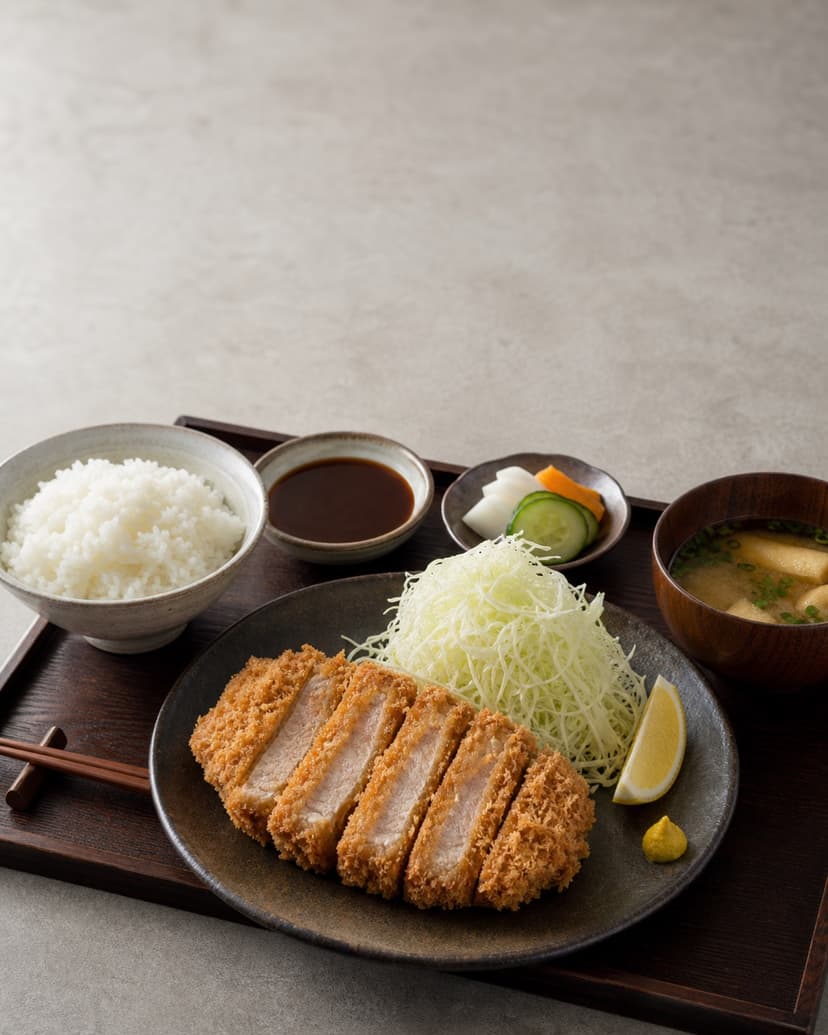
Rosu-katsu made from a genuinely thick pork loin chop, wrapped in coarse airy Japanese panko, gently cooked in a first fry, then flashed hot for a crisp restaurant-style shell. Shredded cabbage and homemade tonkatsu sauce are complete subcomponents, not unexplained extras.
Keep a thick pork chop juicy and safely cooked inside an airy panko shell that stays attached and audibly crisp.
- Place & style
- Japan / yōshoku Japanese · Main
- Yield
- 4 servings Pork · spice 0/5
- Time
- 1 hr 30 min prep · 25 min cook
- Cook level
- Intermediate Japanese · yoshoku · yōshoku · tonkatsu · rosu katsu · Japanese pork cutlet · panko · double fry · teishoku · shredded cabbage · tonkatsu sauce
Bumbu / flavour foundation
measured salt, flour-egg-panko coating, two-stage fry, tonkatsu sauce, cabbage, karashi
Scoring only the connective seam prevents curling without flattening the pork. A whisper-thin flour layer, egg loosened with water, coarse panko pressed only once, and a 10-minute rack rest bond the crust. The lower first fry cooks gently; the brief hotter second fry dries and colours the panko.
Equipment
- 24-28 cm deep heavy pot with lid nearby
- deep-fry thermometer
- instant-read probe thermometer
- wire rack over a tray
- spider or fine skimmer
- three shallow breading trays
- sharp chef’s knife or cabbage mandoline
- salad spinner and clean kitchen towels
Read the visual cue before each step. The clock is guidance; the food decides when you move.
01 · Market sheet
Know what you are buying.
Every ingredient is shown in context, named in English and Bahasa Indonesia, and tied to its job in the dish.Meat or seafoodDaging atau seafood
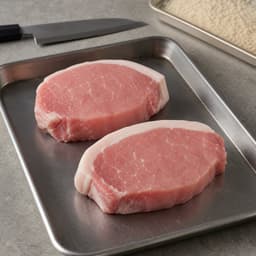
4 × 170 g
boneless thick-cut pork loin chops
daging loin babi tebal tanpa tulang
rosu-katsu centre with enough thickness and fat edge to stay juicy
Watch: This dish contains pork. Do not pound the chops thin; even them to 20-22 mm and verify 63°C internally.
Dry pantryBahan kering
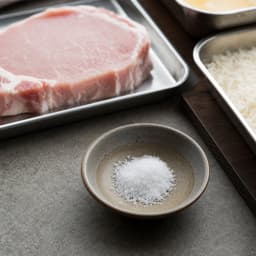
5 g
fine sea salt
garam laut halus
light measured seasoning beneath the salty-sweet sauce
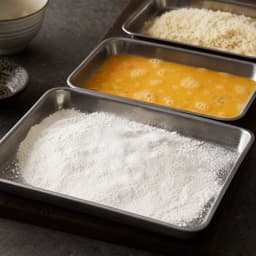
80 g
plain or cake flour
tepung terigu serbaguna atau protein rendah
an extremely thin dry bridge between pork and egg
Watch: Contains wheat and gluten; excess flour becomes a pasty layer that detaches.
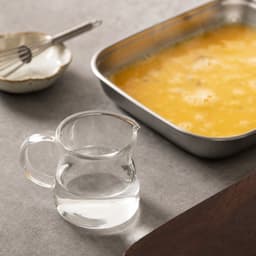
30 ml
water
air
loosens egg so it coats the thin flour layer evenly
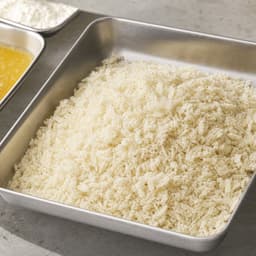
200 g
coarse Japanese panko
tepung roti panko Jepang bertekstur kasar
large airy shards that form the characteristic light crisp shell
Watch: Usually contains wheat and gluten; do not crush the flakes while applying them.

1.5 L
neutral high-heat frying oil
minyak goreng netral tahan panas
deep enough for full submersion and stable two-stage frying
Watch: Fill the pot no more than halfway, keep water away, and never extinguish an oil fire with water.
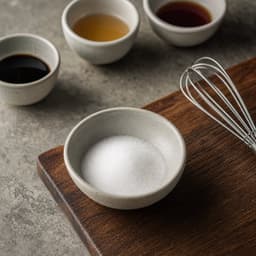
16 g
white sugar
gula putih
rounds the acidic sauces into the familiar sweet-tangy condiment
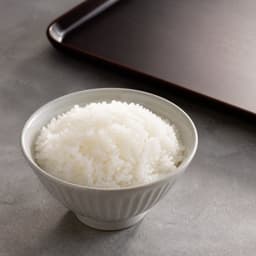
600 g
cooked Japanese short-grain rice, optional
nasi Jepang berbulir pendek matang, opsional
plain starch for a complete teishoku set
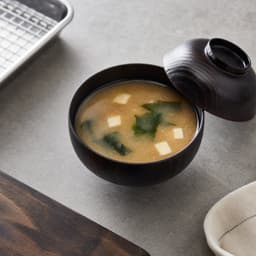
800 ml
prepared miso soup, optional
sup miso siap saji, opsional
traditional warm soup alongside a tonkatsu teishoku
Watch: Miso contains soy; dashi may contain fish and packaged products may contain wheat.
SpicesRempah
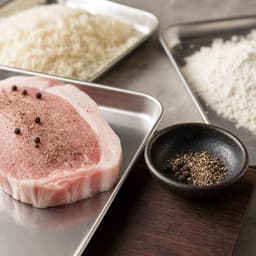
1 g
white or black pepper
lada putih atau hitam
subtle warmth directly on the pork
ChilledDingin
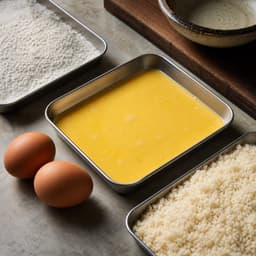
2 eggs
large eggs
telur ayam ukuran besar
wet bridge that holds coarse panko to the floured pork
Watch: Contains egg.
SaucesSaus & bumbu botol
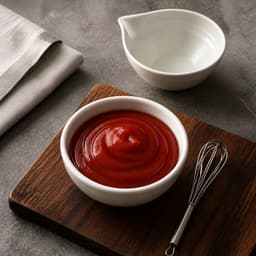
90 g
tomato ketchup
saus tomat ketchup
fruit, sweetness, and body in the beginner tonkatsu sauce
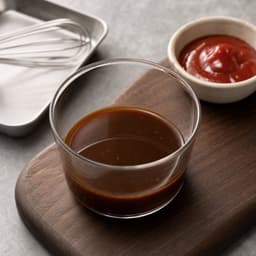
60 ml
Worcestershire-style sauce
saus Worcestershire
spiced tang and savoury depth in the separate tonkatsu sauce
Watch: Brands may contain fish, barley, gluten, or other allergens; check the exact label.
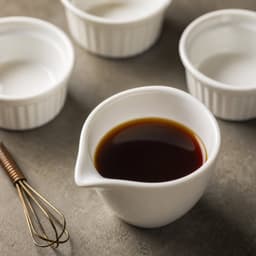
15 ml
Japanese soy sauce
shoyu Jepang
umami and salt in the homemade tonkatsu sauce
Watch: Contains soy and commonly wheat.
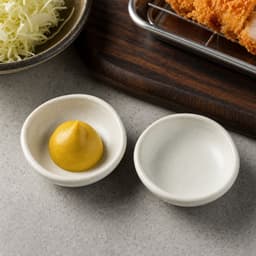
20 g
Japanese hot mustard or karashi
mustard pedas Jepang atau karashi
sharp table condiment kept separate from the sauce
Watch: Contains mustard.
Fresh produceSayur & bahan segar
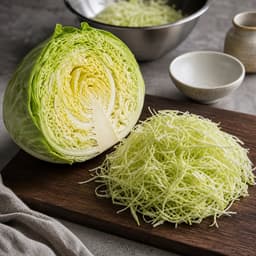
500 g
green cabbage
kol hijau
fine, cold, undressed crunch that resets the palate after fried pork
Watch: Slice to about 1 mm, crisp briefly in ice water, then spin and towel completely dry.
GarnishPelengkap
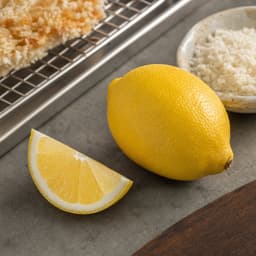
1 lemon
lemon
lemon
fresh acid served as a wedge rather than soaked into the crust
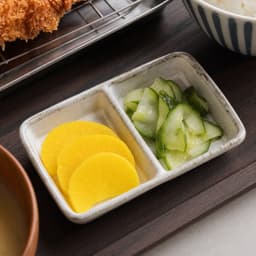
120 g
Japanese pickles, optional
acar Jepang, opsional
small acidic, crunchy side for the complete set
Watch: Check packaged pickles for soy, wheat, fish, colours, and preservatives.
02 · Method
Cook in order. Read the decisive cue.
8 stages · 1 hr total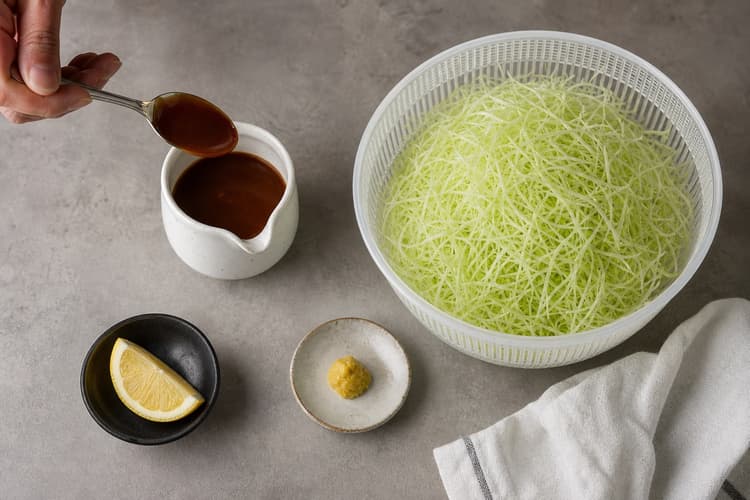
Stage 01
Make sauce and dry crisp cabbage
Combine ketchup, Worcestershire, soy, and sugar over medium heat; stir until small bubbles appear, 1-2 minutes, then cool. Slice cabbage into strands no wider than 1 mm, soak in ice water for 5 minutes, spin thoroughly, and towel it completely dry. Keep sauce, cabbage, lemon, and karashi separate.
- Move on when
- The sauce is glossy and spoonable; cabbage is cold, airy, and crisp with no visible water.
- Common mistake
- Wet cabbage leaks onto the panko, while boiling the sauce hard makes it sticky and too salty.
- Recovery
- Lower the heat immediately, skim or stir gently, and continue at a small simmer until the surface calms.
Stage 02
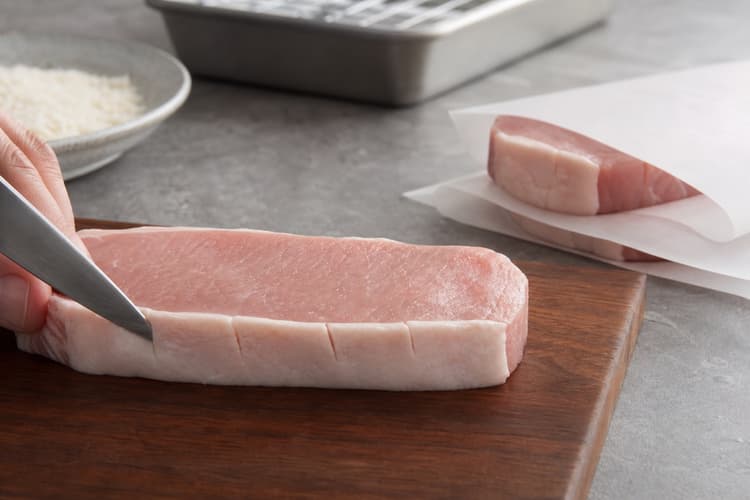
Score and even the thick pork
Keep a 4-5 mm fat edge. Cut only through the tough connective seam between fat and meat every 2 cm on both sides. Tap each chop lightly between parchment until it is an even 20-22 mm, reshape it, pat dry, then apply the measured salt and pepper. Rest refrigerated for 10 minutes.
- Move on when
- Each chop is a flat, even oval with no tight fat band and remains visibly thick rather than schnitzel-thin.
- Common mistake
- Heavy pounding dries the pork; fold a thin irregular edge inward before coating and rely on the thermometer rather than a fixed time.
- Recovery
- Reduce uncovered and season in small rounds, checking the visual cue before adding more salt, sugar, or sauce.
Stage 03
Build a clean flour-and-egg bond
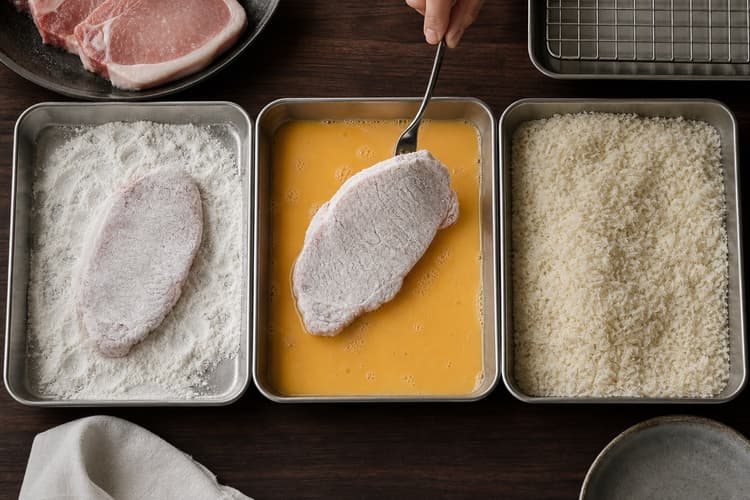
Put flour in tray one, eggs beaten thoroughly with 30 ml water in tray two, and loose panko in tray three. Coat every pork surface in a whisper-thin flour layer and shake firmly. Dip fully in egg, lift with a fork or tongs, and let the excess run off.
- Move on when
- There are no wet bare spots, chalky clumps, or thick drips before the chop enters the panko.
- Common mistake
- Thick flour turns pasty and detaches; brush it off and repeat the flour stage before dipping in egg.
- Recovery
- Pause before the next step, compare the cue, then correct heat, moisture, or seasoning while the dish is still flexible.
Stage 04
Apply airy panko and rest
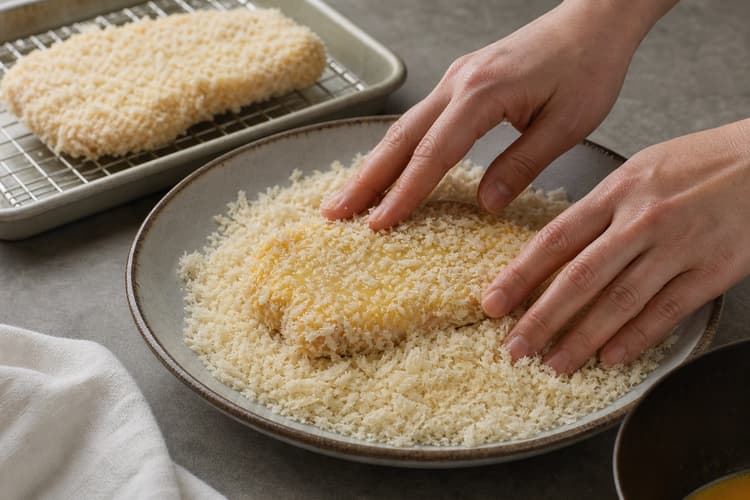
Lay the egg-coated chop in coarse panko, scatter more over it, and press only once with open fingertips. Do not squeeze or crush the long shards. Rest each coated chop on a wire rack for 10 minutes and patch only obvious bare spots.
- Move on when
- The coating is rough and dimensional, remains attached when lifted, and has no dark compressed wet patches.
- Common mistake
- Crushed fine crumb creates a dense greasy shell; lift away compacted clumps and replace them with loose coarse panko.
- Recovery
- Pause before the next step, compare the cue, then correct heat, moisture, or seasoning while the dish is still flexible.
Stage 05
First-fry gently at 160-165°C
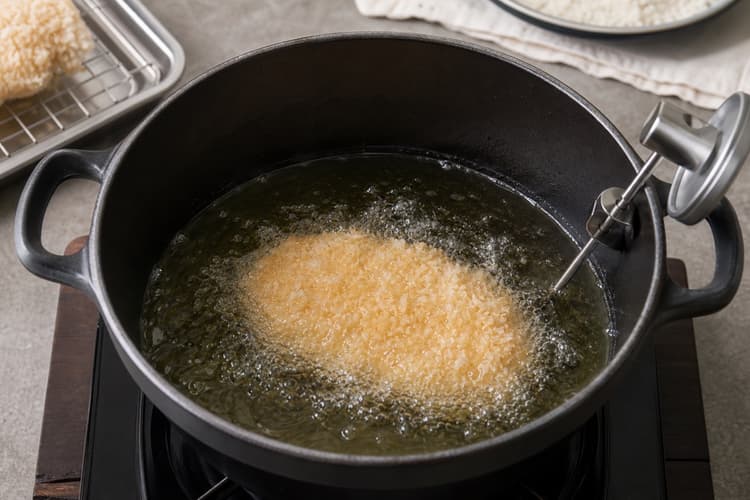
Fill the pot no more than halfway with oil and heat to 160-165°C. Fry no more than two chops, only if they do not touch and the oil recovers above 155°C within 30 seconds. Leave them untouched for 90 seconds, cook 3 minutes on the first side and 2 minutes on the second, then lift carefully.
- Move on when
- Gentle steady bubbles surround a pale straw-gold intact crust; the oil never smokes or fills with burnt crumbs.
- Common mistake
- Crowding crashes the temperature and makes panko oily; remove one chop, let the oil recover, and continue one at a time.
- Recovery
- Pause before the next step, compare the cue, then correct heat, moisture, or seasoning while the dish is still flexible.
Stage 06
Rest vertically and clean the oil
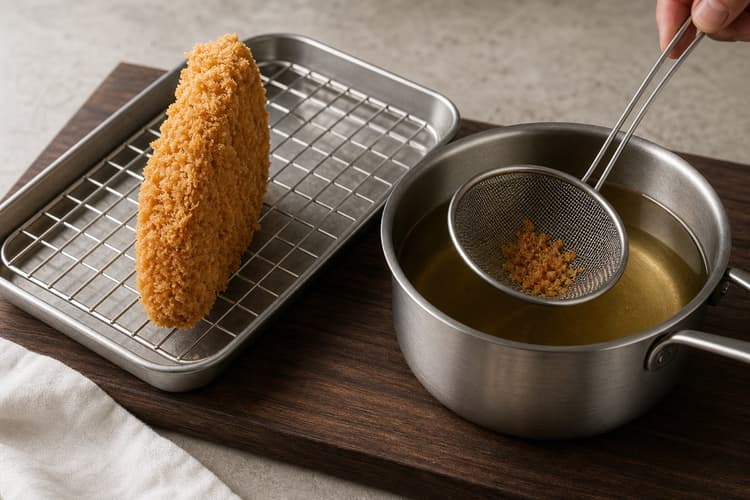
Stand first-fried cutlets nearly upright on the rack for 3 minutes so hot oil and steam can escape from both faces. Skim every loose crumb from the pot, then raise the clean oil to 185°C. Never drain on flat paper towels.
- Move on when
- The pale crust stays dry and exposed, no oil puddle forms, and the second-fry oil contains no black crumbs.
- Common mistake
- A flat or stacked rest traps steam and softens the underside; move the cutlets to a rack and lean them apart.
- Recovery
- Spread the food out, raise heat only after moisture drops, and hold back extra sauce until the pan is frying again.
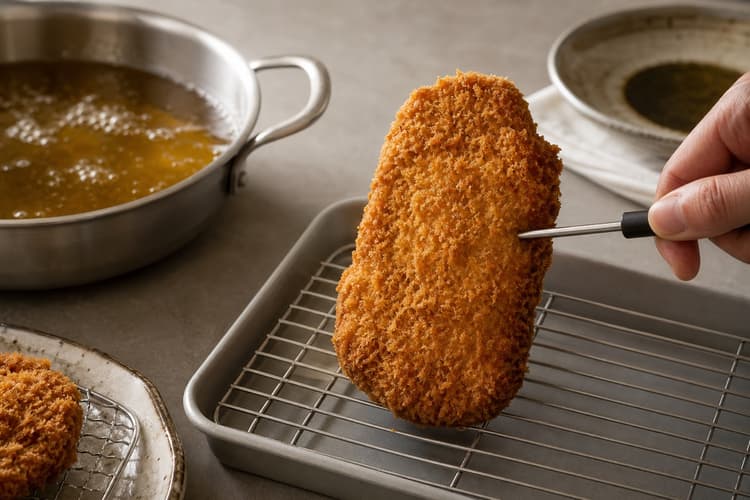
Stage 07
Flash-fry, probe, and safety-rest
Return cutlets to 185°C for 30 seconds per side, about 1 minute total. Drain vertically. Insert a clean probe horizontally through one narrow edge into the thickest centre; every chop must reach at least 63°C, then rest for at least 3 minutes. If low, return it at 165-170°C in 30-second intervals - not at 185°C - until safe.
- Move on when
- The crust is evenly rich gold, airy and dry; the centred probe reads at least 63°C without relying on pork colour.
- Common mistake
- Keeping underdone pork at 185°C burns panko before the centre is safe; lower the oil and correct in short measured intervals.
- Recovery
- Re-cover the cup and continue at the gentlest steam in 2-minute increments. Stop when the centre wobbles as one mass and the safety temperature is reached.
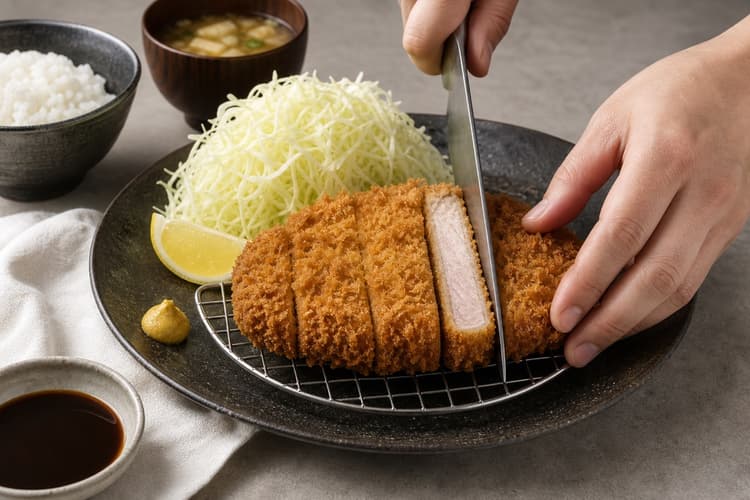
Stage 08
Slice straight down and build the set
After the safety rest, make one straight downward knife stroke for each 18-20 mm strip; do not saw. Keep the strips aligned. Plate immediately with dry cabbage, lemon, karashi, and sauce in a separate vessel. Add optional short-grain rice, miso soup, and pickles for a complete teishoku.
- Move on when
- Panko stays attached to juicy pork, cabbage remains fluffy, and diners add sauce bite by bite without soaking the whole crust.
- Common mistake
- Cutting immediately, sawing, stacking, or pouring sauce over every strip tears or steams away the crisp shell.
- Recovery
- Spread the food out, raise heat only after moisture drops, and hold back extra sauce until the pan is frying again.
03 · Source & shop
Where the guidance comes from.
Technique guidance is stable editorial material. Prices, stock, and local availability should be rechecked before a special trip.Melbourne
- Best source: start at a Japanese grocer for boneless thick-cut pork loin chops, white or black pepper, plain or cake flour; buy boneless thick-cut pork loin chops, fine sea salt, plain or cake flour from a high-turnover Melbourne supermarket, butcher, poultry shop, or fishmonger.
- Japanese pantry watch: compare exact labels for fine sea salt, white or black pepper, plain or cake flour; protect boneless thick-cut pork loin chops because it changes the identity or technique of Japanese Pork Tonkatsu.
- Acceptable swaps: boneless thick-cut pork loin chops: four 20 mm pork tenderloin medallions for leaner hire-katsu; plain or cake flour: fine rice flour for a gluten-free coating.
- Allergen check: wheat, gluten, egg, soy, mustard, fish depending on sauces and dashi, pork; read every sauce, stock, crumb, and packaged Japanese ingredient rather than relying on the category name.
- Fresh vs packaged: buy green cabbage fresh or properly chilled; packaged fine sea salt, white or black pepper, plain or cake flour is useful when the seal and use-by date are sound.
Jakarta
- Best source: use a Japanese supermarket or trusted online grocer for daging loin babi tebal tanpa tulang, lada putih atau hitam, tepung terigu serbaguna atau protein rendah; buy boneless thick-cut pork loin chops, fine sea salt, plain or cake flour from high-turnover Jakarta fresh suppliers.
- Japanese pantry watch: compare labels for fine sea salt, white or black pepper, plain or cake flour; imported specialist items should remain cold, sealed, and within date.
- Acceptable swaps: boneless thick-cut pork loin chops: four 20 mm pork tenderloin medallions for leaner hire-katsu; plain or cake flour: fine rice flour for a gluten-free coating.
- Allergen check: wheat, gluten, egg, soy, mustard, fish depending on sauces and dashi, pork; verify packaged products and pork, halal, or alcohol requirements for the exact brands you choose.
- Fresh vs packaged: use well-chilled proteins and clean produce or eggs; packaged fine sea salt, white or black pepper, plain or cake flour is fine when dates and refrigeration are reliable.
Editorial provenance
Kikkoman Japan - Tonkatsu (Japanese Pork Cutlet)
Cross-checks a thick pork-loin cut, scoring the connective tissue, light evening, flour-egg-panko breading, a short rack rest, controlled frying, shredded cabbage, mustard, and tonkatsu sauce.
Supports: thick pork loin and sinew scoring, flour, egg, and coarse panko sequence, cabbage, mustard, and sauce service.
Boundary: Kikkoman uses one 170°C fry, demonstrating that double-frying is not required to define tonkatsu. Bumbu Lens uses a rest and brief second fry as one controlled thick-cut technique, not as a universal Japanese rule.
Reviewed 2026-07-10Government of Japan - The Roots of Tonkatsu
Uses a Japanese government interview with the restaurant credited as the first to menu the dish to ground tonkatsu in yoshoku: a Western cutlet reworked in Japan with thick pork, fresh breadcrumbs, deep frying, shredded cabbage, and sauce.
Supports: Japanese yoshoku context, thick pork and fresh breadcrumb identity, cabbage and sauce service.
Boundary: This is cultural history and restaurant testimony, not a domestic recipe specification. Origin stories and individual restaurant frying methods should be attributed rather than treated as the only legitimate tonkatsu.
Reviewed 2026-07-10JETRO Taste of Japan - Inside Tonkatsu
Cross-checks coarse panko, thick juicy pork, a lower-temperature first fry, an out-of-oil rest, and a brief hotter second fry for renewed crust crispness.
Supports: coarse airy panko, lower fry then rest, brief hotter second fry.
Boundary: JETRO presents double-frying as a high-quality technique, while Kikkoman's equally valid recipe single-fries. The second fry is therefore an optional thick-cut control strategy, not an authenticity test.
Reviewed 2026-07-10Kikkoman - Japanese Fusion Cuisine: Tonkatsu and yoshoku
Cross-checks the Japanese reinterpretation of European breaded cutlets, the term's pork-and-cutlet etymology, the role of crisp grated-bread coating, and the development of thick Japanese tonkatsu sauces.
Supports: yoshoku development, bread-crumb crust identity, Japanese tonkatsu sauce context.
Boundary: This is a food-culture essay from a soy-sauce producer, not a tested frying schedule; it supports terminology and context rather than exact oil temperature or doneness.
Reviewed 2026-07-10FoodSafety.gov - Safe Minimum Internal Temperatures
Applies 63°C / 145°F followed by a three-minute rest to an intact pork chop and requires a side-entering probe in the thickest part; residual heat during the rack rest can continue the cook.
Supports: 63°C whole-cut pork minimum, three-minute rest, side-entry thermometer check.
Boundary: Golden panko, elapsed frying time, steam, and a pale-pink centre are not independent safety tests. Ground, mechanically tenderised, or stuffed pork needs different controls from an intact loin chop.
Reviewed 2026-07-10Bumbu Lens generated visual cue reference
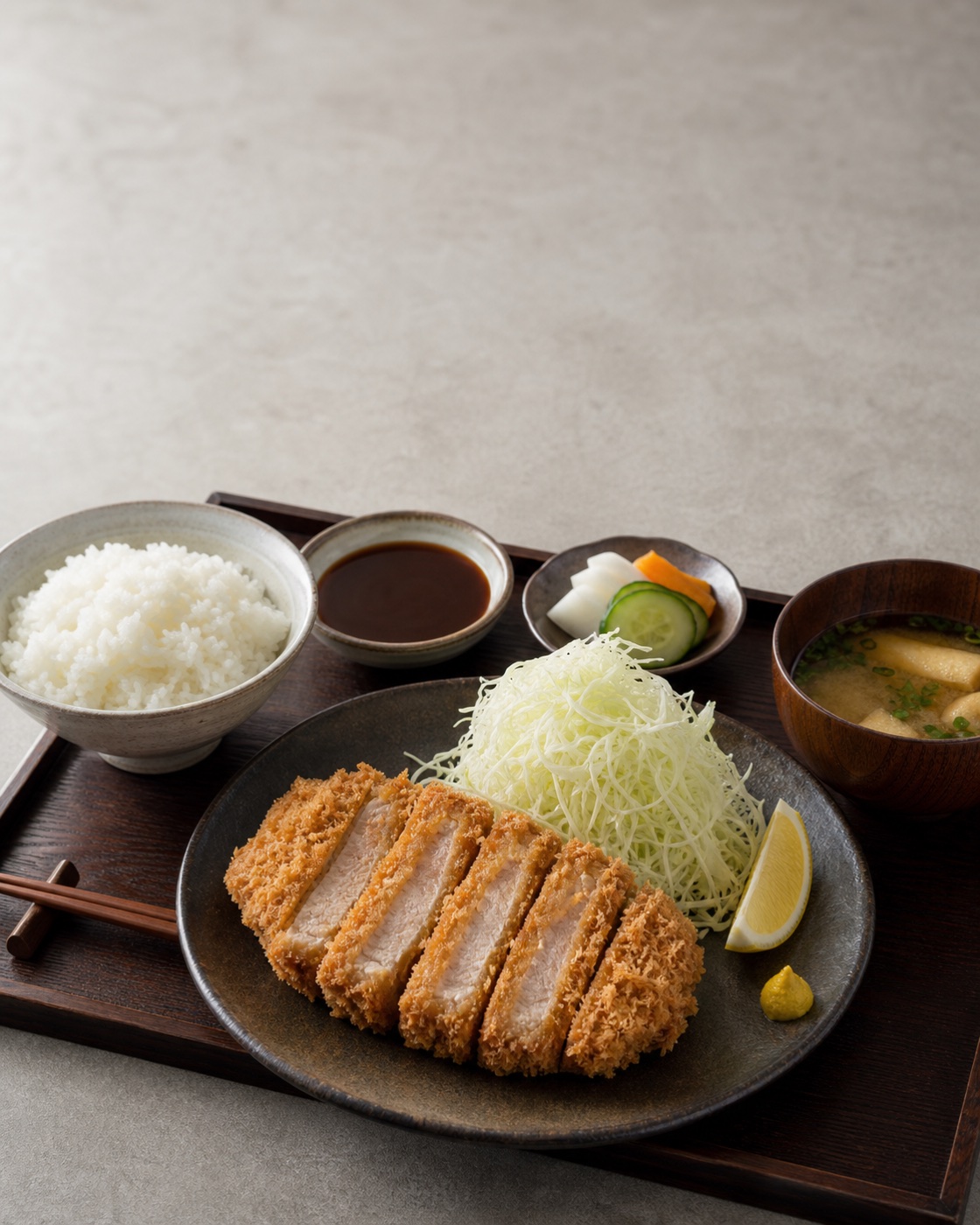
Recorded as a local editorial or generated visual cue asset, not an independent external source.
Supports: finished-dish appearance, image credit boundary.
Boundary: A local or generated asset is visual guidance, not evidence of authenticity, ingredient quantities, timing, safety, or method accuracy.
Reviewed 2026-07-10Bumbu Lens editorial method audit
Reviewed Japanese Pork Tonkatsu as an ordered cook flow with visual cues, common mistakes, and recovery notes.
Supports: method sequence, visual checkpoints, mistake and recovery notes.
Boundary: Use this as editorial guidance; run a tested-kitchen pass before publishing nutrition, safety guarantees, or commercial pack quantities.
Reviewed 2026-07-10Bumbu Lens Melbourne/Jakarta sourcing heuristic
Mapped ingredient groups to likely Melbourne grocer, supermarket, butcher, pasar, and Jakarta supermarket paths.
Supports: Melbourne sourcing, Jakarta sourcing, volatile availability boundary.
Boundary: Ingredient availability, price, and store stock change; verify with local grocers before travel, bulk shopping, or holiday cooking.
Reviewed 2026-07-10Your next cook
Kitchen notes
Record the batch size, timing, substitutions, and visual cue you want to remember next time.