Recipe 17 / 19
JP · Japan
Chawanmushi
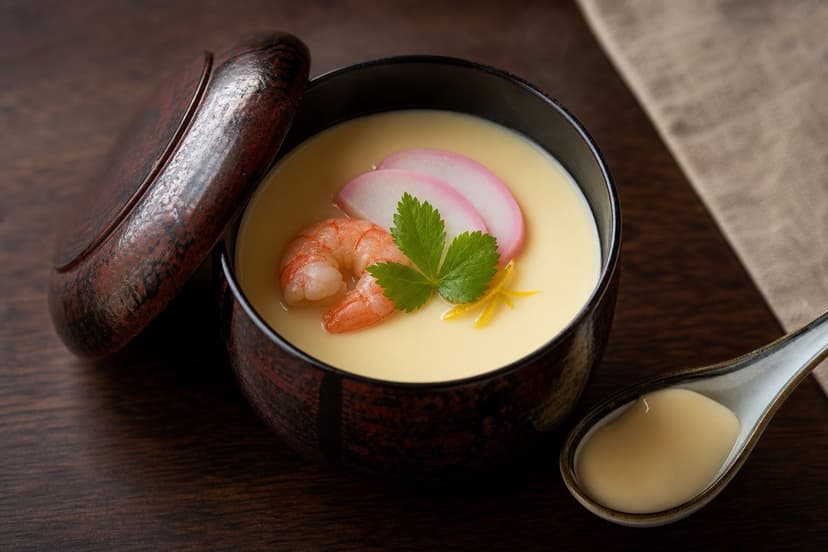
Japanese steamed savoury egg custard made at a precise one-to-three egg-to-dashi ratio, hiding tender chicken, shrimp, shiitake, and kamaboko beneath a glossy surface.
Set a glossy, spoonable custard with no bubbles, stringy egg, or honeycomb holes.
- Place & style
- Japan / washoku Japanese · Soup
- Yield
- 4 individual cups Egg · spice 0/5
- Time
- 50 min 25 min prep · 25 min cook
- Cook level
- Intermediate Japanese · washoku · steamed · savoury egg custard · chawan mushi · chawan musi · Japanese steamed egg · dairy-free
Bumbu / flavour foundation
dashi, egg, usukuchi soy, mirin, gentle steam
Weighing one part egg to three parts room-temperature dashi controls the set. Gentle mixing, fine straining, covered cups, and a barely simmering water bath prevent foam and porous curdling.
Equipment
- four 220 ml heatproof cups
- wide lidded steamer or pot
- thin cloth or silicone rack
- fine sieve
- digital scales
- instant-read thermometer
Read the visual cue before each step. The clock is guidance; the food decides when you move.
01 · Market sheet
Know what you are buying.
Every ingredient is shown in context, named in English and Bahasa Indonesia, and tied to its job in the dish.Dry pantryBahan kering
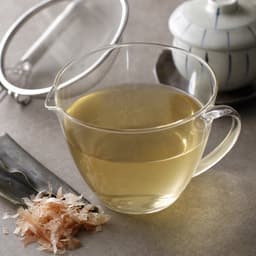
600 ml
unsalted dashi
kaldu dashi tanpa garam
the main flavour and three-part liquid in the delicate custard
Watch: Most dashi contains fish; use kombu-shiitake dashi for a vegetarian version.
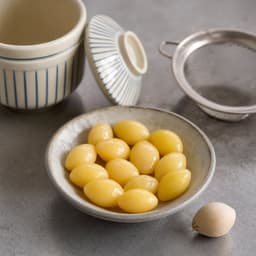
16 g
canned ginkgo nuts
biji ginkgo kalengan
optional traditional bittersweet discovery inside each cup
Watch: Use only 1-2 prepared nuts per cup; too many taste bitter.
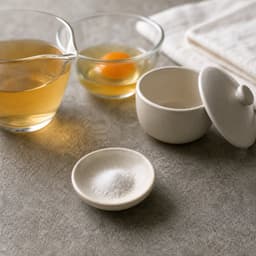
3 g
fine sea salt
garam laut halus
brings the custard close to the classic lightly seasoned set
Watch: Reduce this when instant dashi or regular soy is already salty.
ChilledDingin
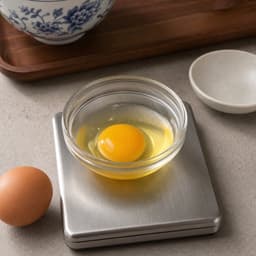
150 g
whole egg, weighed without shell
telur utuh, ditimbang tanpa cangkang
one structural part to exactly three parts dashi
Watch: Egg sizes vary: weigh the egg and use three times its weight in dashi.
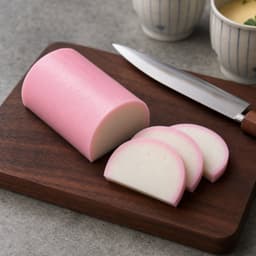
24 g
kamaboko fish cake
kue ikan kamaboko
traditional colour, fish flavour, and a tender bounce
Watch: Packaged kamaboko may contain fish, egg, soy, and wheat; read the label.
Meat or seafoodDaging atau seafood
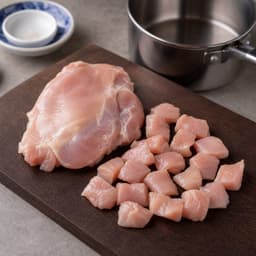
60 g
boneless skinless chicken thigh
paha ayam tanpa tulang dan kulit
small savoury filling pre-poached for beginner-safe doneness
Watch: Cut into eight even 1.5 cm pieces and pre-cook to 74°C.
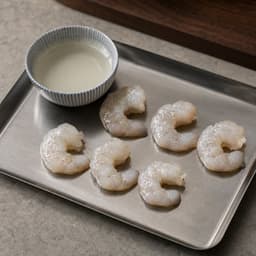
48 g
peeled deveined small shrimp
udang kecil kupas tanpa urat
traditional seafood filling added late so it stays tender
Watch: Contains crustacean; poach only until pearly, opaque, and just firm.
Fresh produceSayur & bahan segar
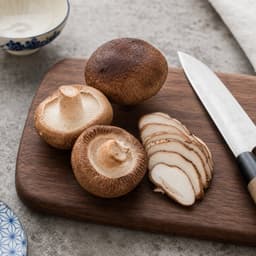
20 g
fresh shiitake mushrooms
jamur shiitake segar
earthy umami and a soft contrasting slice
SaucesSaus & bumbu botol
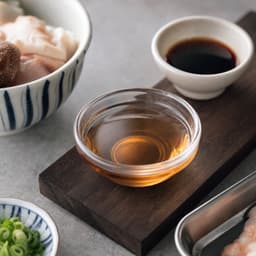
15 g
usukuchi light Japanese soy sauce
shoyu usukuchi
salty umami without turning the custard brown
Watch: Contains soy and commonly wheat.
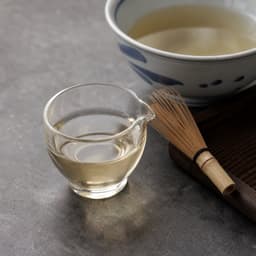
10 g
mirin
mirin
subtle sweetness and washoku seasoning
Watch: Traditional mirin contains alcohol; use the stated substitute when required.
GarnishPelengkap
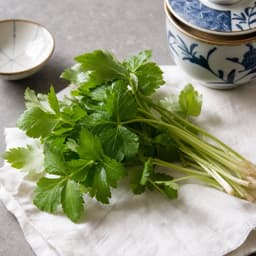
4 g
mitsuba
daun mitsuba
delicate Japanese herb garnish added after steaming
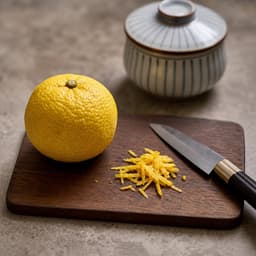
0.5 g
yuzu peel
kulit yuzu
optional fine citrus perfume on the finished cup
02 · Method
Cook in order. Read the decisive cue.
7 stages · 50 min total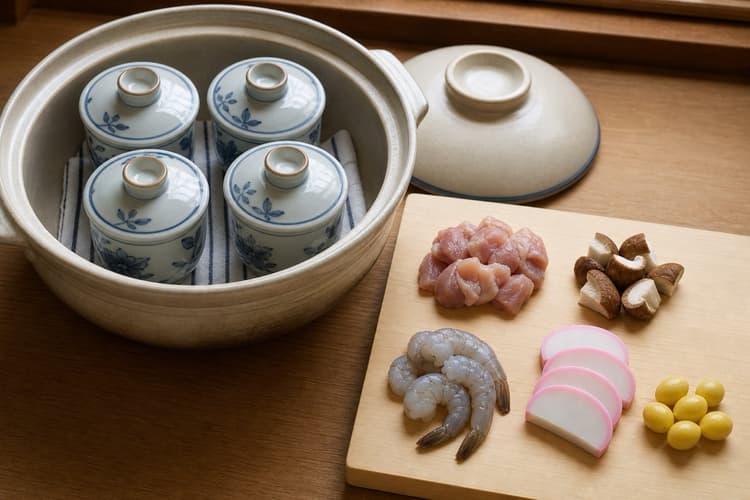
Stage 01
Fit the cups and cut fillings evenly
Before filling anything, confirm all four cups fit without touching and the pot lid closes. Place a folded thin cloth or silicone rack beneath them. Cut chicken into eight even 1.5 cm pieces, slice shiitake 4-5 mm thick, and keep small shrimp whole.
- Move on when
- Cups sit level and stable; every chicken piece is small enough to heat at the same rate.
- Common mistake
- Crowded cups rattle and large raw chicken pieces heat too slowly.
- Recovery
- Pause before the next step, compare the cue, then correct heat, moisture, or seasoning while the dish is still flexible.
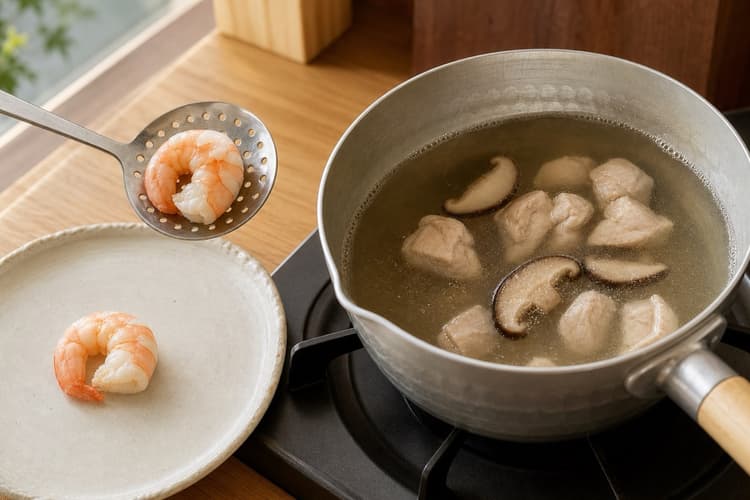
Stage 02
Pre-poach chicken, mushroom, and shrimp
Bring 150 ml dashi and 5 g soy to a gentle simmer. Cook chicken 3-4 minutes to 74°C, adding shiitake for the final 2 minutes. Remove both, then poach shrimp 60-90 seconds until pearly and opaque. Cool the fillings and discard the cloudy poaching liquid rather than adding it to custard.
- Move on when
- Chicken is safely opaque, shrimp just firm, and no cloudy meat juices enter the egg base.
- Common mistake
- Leaving shrimp for the full steam makes it rubbery; raw watery fillings weaken the set.
- Recovery
- Spread the food out, raise heat only after moisture drops, and hold back extra sauce until the pan is frying again.
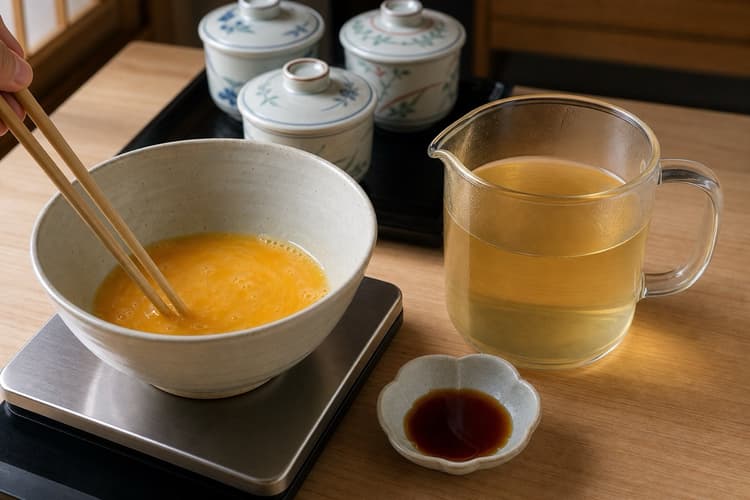
Stage 03
Weigh the exact one-to-three custard
Combine 450 g room-temperature dashi with 10 g soy, mirin, and salt. Weigh shelled eggs: for any amount other than 150 g, use exactly three times that weight of seasoned dashi. Break yolks, then stir side-to-side with chopsticks against the bowl bottom instead of whisking air in.
- Move on when
- Egg and dashi are evenly combined at 1:3 by weight with almost no foam.
- Common mistake
- Counting eggs without weighing changes the ratio; hot dashi makes stringy scrambled flecks.
- Recovery
- Pause before the next step, compare the cue, then correct heat, moisture, or seasoning while the dish is still flexible.
Stage 04
Strain, fill, and cover the cups
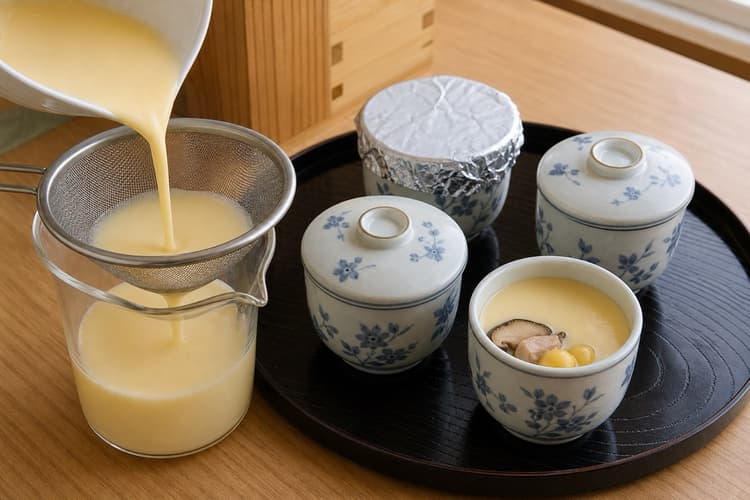
Add seasoned dashi to egg in three additions, stirring gently. Pass through a fine sieve into a jug and skim bubbles. Divide chicken, shiitake, and optional ginkgo among cups; add about 155 g custard to each with 1-1.5 cm headspace. Pop bubbles and cover every cup with its lid or foil.
- Move on when
- The surface is pale, completely smooth, and protected from condensation.
- Common mistake
- Unstrained white makes streaks; uncovered cups collect drips that pit and dilute the surface.
- Recovery
- Pause before the next step, compare the cue, then correct heat, moisture, or seasoning while the dish is still flexible.
Stage 05
Steam at the quietest simmer
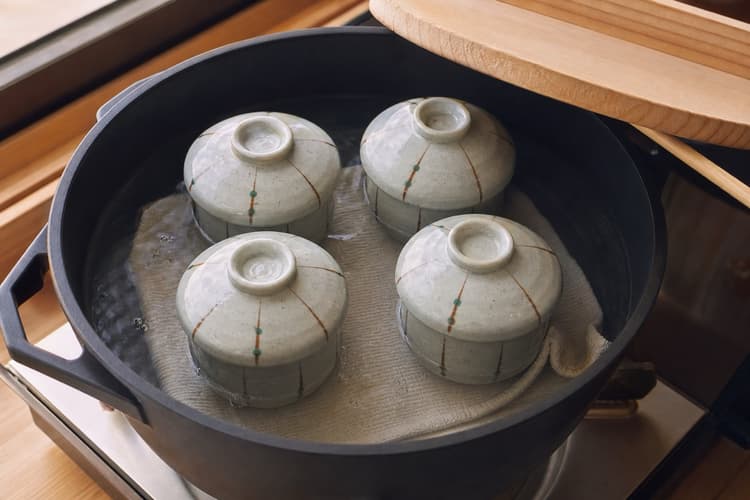
Arrange covered cups on the cloth, add warm water to one-third their height, and cover the pot. Use medium heat only until water reaches a bare simmer, then immediately turn to the lowest heat and prop the pot lid open about 1 cm with a chopstick.
- Move on when
- Water gives an occasional quiet plop; cups do not rattle and no rolling boil is visible.
- Common mistake
- High trapped steam overheats egg into honeycomb holes and rubbery curds.
- Recovery
- The texture cannot be reversed, but it is usually still edible if safely cooked. Serve this batch gently, then lower the water to a bare simmer, crack the lid, and shorten the next steam.
Stage 06
Test the wobble and add visible fillings
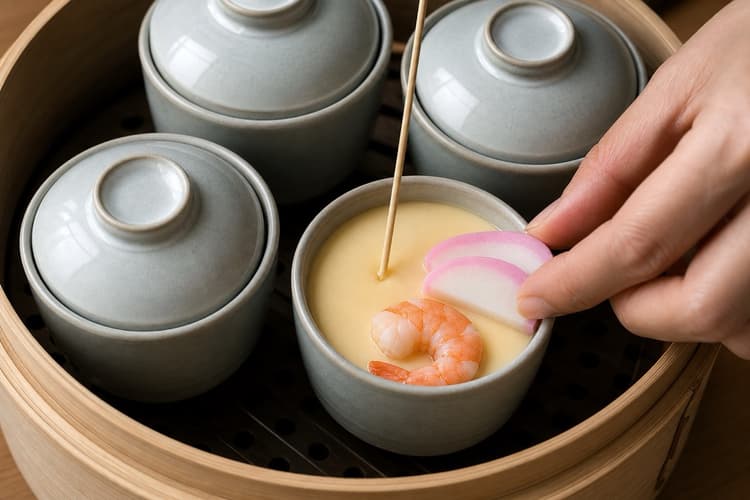
After 14 minutes, open the lid away from your face. The edge should be set and centre move as one soft jelly; if it waves like liquid, continue in 2-minute increments. Once it supports weight, place one cooked shrimp and two kamaboko slices on each cup, re-cover, and steam 2-3 minutes.
- Move on when
- A skewer near the centre releases clear dashi, not milky egg; centre temperature is about 77-80°C.
- Common mistake
- A liquid wave is underdone, but chasing a stiff set squeezes water from overheated egg.
- Recovery
- Re-cover the cup and continue at the gentlest steam in 2-minute increments. Stop when the centre wobbles as one mass and the safety temperature is reached.
Stage 07
Rest covered, garnish, and spoon
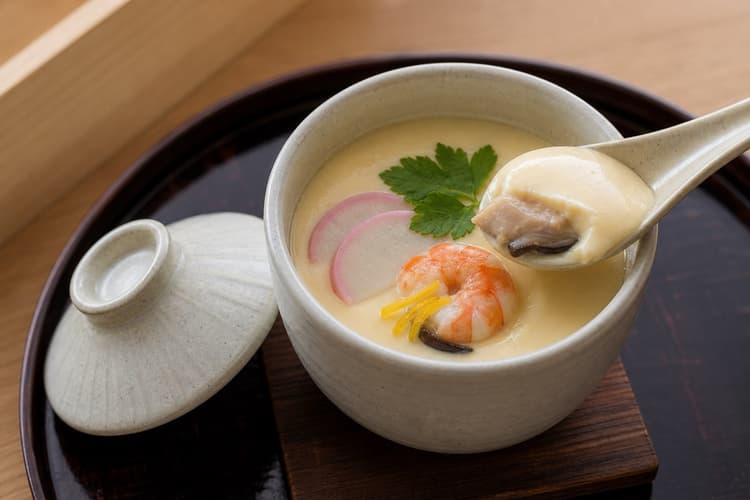
Turn off heat and rest covered for 3 minutes so residual heat completes the set gently. Add mitsuba and fine yuzu peel. Serve hot in the cooking cup with a small spoon and warn diners that the ceramic is hot.
- Move on when
- The glossy pale custard trembles softly and spoons like silk between soft tofu and barely set custard.
- Common mistake
- Freezing or hard reheating causes porous texture and clear liquid separation.
- Recovery
- The texture cannot be reversed, but it is usually still edible if safely cooked. Serve this batch gently, then lower the water to a bare simmer, crack the lid, and shorten the next steam.
03 · Source & shop
Where the guidance comes from.
Technique guidance is stable editorial material. Prices, stock, and local availability should be rechecked before a special trip.Melbourne
- Best source: start at a Japanese grocer for unsalted dashi, whole egg, weighed without shell, boneless skinless chicken thigh; buy unsalted dashi, whole egg, weighed without shell, boneless skinless chicken thigh from a high-turnover Melbourne supermarket, butcher, poultry shop, or fishmonger.
- Japanese pantry watch: compare exact labels for unsalted dashi, canned ginkgo nuts, usukuchi light Japanese soy sauce; protect unsalted dashi because it changes the identity or technique of Chawanmushi.
- Acceptable swaps: unsalted dashi: make from 700 ml water, 7 g kombu, and 14 g katsuobushi; instant dashi is fine if salt is adjusted; boneless skinless chicken thigh: omit for a pescatarian version.
- Allergen check: egg, fish, crustacean, soy, wheat depending on kamaboko; read every sauce, stock, crumb, and packaged Japanese ingredient rather than relying on the category name.
- Fresh vs packaged: buy fresh shiitake mushrooms fresh or properly chilled; packaged unsalted dashi, canned ginkgo nuts, usukuchi light Japanese soy sauce is useful when the seal and use-by date are sound.
Jakarta
- Best source: use a Japanese supermarket or trusted online grocer for kaldu dashi tanpa garam, telur utuh, ditimbang tanpa cangkang, paha ayam tanpa tulang dan kulit; buy unsalted dashi, whole egg, weighed without shell, boneless skinless chicken thigh from high-turnover Jakarta fresh suppliers.
- Japanese pantry watch: compare labels for unsalted dashi, canned ginkgo nuts, usukuchi light Japanese soy sauce; imported specialist items should remain cold, sealed, and within date.
- Acceptable swaps: unsalted dashi: make from 700 ml water, 7 g kombu, and 14 g katsuobushi; instant dashi is fine if salt is adjusted; boneless skinless chicken thigh: omit for a pescatarian version.
- Allergen check: egg, fish, crustacean, soy, wheat depending on kamaboko; verify packaged products and pork, halal, or alcohol requirements for the exact brands you choose.
- Fresh vs packaged: use well-chilled proteins and clean produce or eggs; packaged unsalted dashi, canned ginkgo nuts, usukuchi light Japanese soy sauce is fine when dates and refrigeration are reliable.
Editorial provenance
Japan MAFF - Chawanmushi (Japanese steamed egg custard)
Uses an official Japanese recipe to cross-check dashi-led egg custard, straining, covered cups, a water bath, and lowering the heat before the water boils.
Supports: Japanese dish identity, dashi and egg structure, strain, cover, and steam gently.
Boundary: MAFF's example contains chicken and prawns and is one valid filling set; fillings vary, while smooth low-heat coagulation remains the transferable technique.
Reviewed 2026-07-10Kikkoman Japan - Basic Chawanmushi
Cross-checks the classic 1:3 egg-to-dashi relationship, avoiding watery fillings, and controlling the steamer environment below 80°C to protect a smooth, tender set.
Supports: 1:3 egg-to-dashi ratio, low-moisture fillings, sub-80°C steamer control.
Boundary: The page is in Japanese and describes one household method. Egg size, cup material, filling temperature, and steamer geometry still change set time.
Reviewed 2026-07-10Kikkoman Global - Chawan-mushi
Cross-checks cooling the seasoned broth before combining it with egg, straining the custard, portioning fillings, and steaming over low heat for a smooth surface.
Supports: cool broth before egg, strain custard, low-heat steaming.
Boundary: Its 1:2 egg-to-dashi formula is firmer than the 1:3 Japanese home-cooking reference, demonstrating legitimate variation rather than a universal ratio.
Reviewed 2026-07-10Journal of Cookery Science of Japan - Rheological properties of chawan mushi
Uses experimental texture research to distinguish egg-gel formation from surface appearance and to ground why temperature, dilution, salt, and pH change chawanmushi set and water release.
Supports: egg solution gelation behaviour, temperature effect on set, salt and dilution effect on texture.
Boundary: Laboratory rheology does not translate into one domestic steaming time; the app still relies on cup-level visual and temperature checks.
Reviewed 2026-07-10FoodSafety.gov - Safe Minimum Internal Temperatures
Applies 71°C / 160°F to egg dishes and 74°C / 165°F to any poultry filling. Small chicken pieces must be cooked through without forcing the surrounding custard into a hard boil.
Supports: 71°C egg-dish minimum, 74°C poultry minimum, thermometer verification.
Boundary: A just-set wobble is a texture cue, not a complete safety test when raw egg, chicken, or seafood fillings are present; verify the centre and the largest protein piece.
Reviewed 2026-07-10Food Standards Australia New Zealand - Food safety basics
Applies Australian controls to raw egg, chicken, and prawn preparation: prevent cross-contamination, keep perishables at 5°C or colder, cook thoroughly, and avoid extended room-temperature holding.
Supports: raw ingredient separation, 5°C cold storage, thorough cooking.
Boundary: General food-safety guidance cannot resolve custard texture; use gentle steam for quality while independently verifying safe internal temperatures.
Reviewed 2026-07-10Bumbu Lens generated visual cue reference
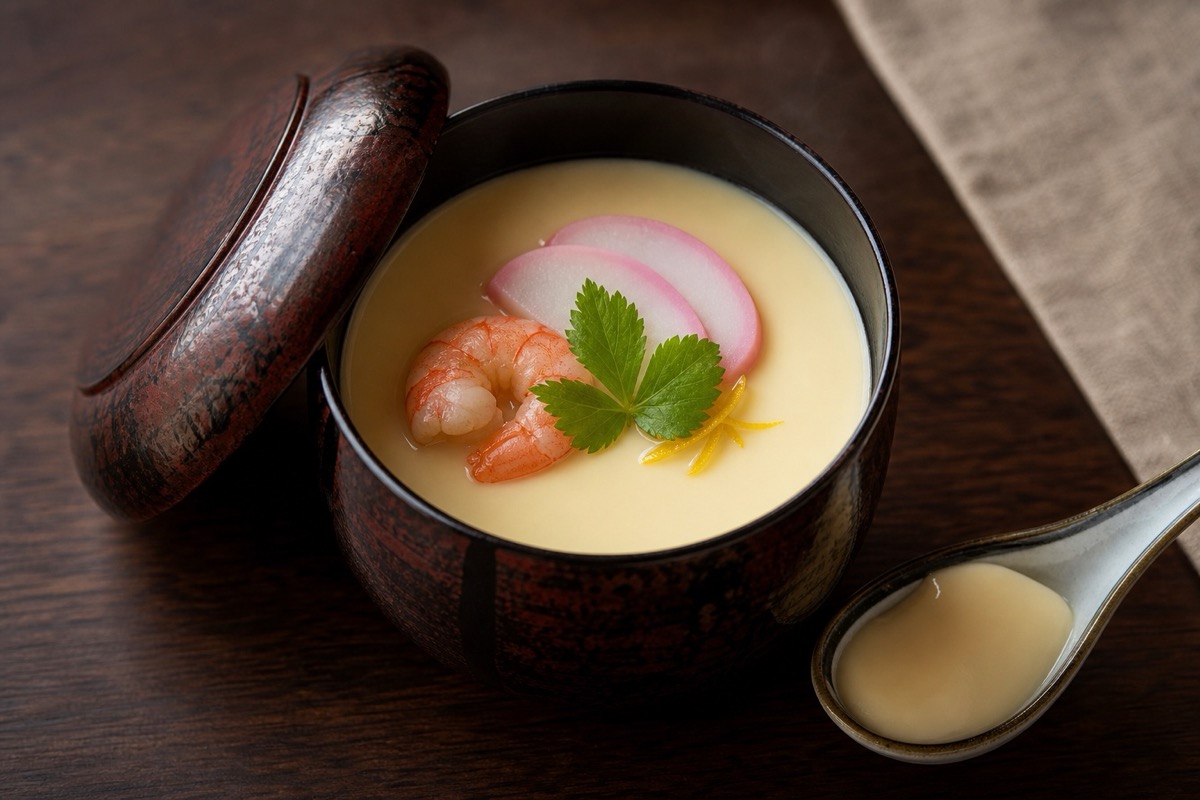
Recorded as a local editorial or generated visual cue asset, not an independent external source.
Supports: finished-dish appearance, image credit boundary.
Boundary: A local or generated asset is visual guidance, not evidence of authenticity, ingredient quantities, timing, safety, or method accuracy.
Reviewed 2026-07-10Bumbu Lens editorial method audit
Reviewed Chawanmushi as an ordered cook flow with visual cues, common mistakes, and recovery notes.
Supports: method sequence, visual checkpoints, mistake and recovery notes.
Boundary: Use this as editorial guidance; run a tested-kitchen pass before publishing nutrition, safety guarantees, or commercial pack quantities.
Reviewed 2026-07-10Bumbu Lens Melbourne/Jakarta sourcing heuristic
Mapped ingredient groups to likely Melbourne grocer, supermarket, butcher, pasar, and Jakarta supermarket paths.
Supports: Melbourne sourcing, Jakarta sourcing, volatile availability boundary.
Boundary: Ingredient availability, price, and store stock change; verify with local grocers before travel, bulk shopping, or holiday cooking.
Reviewed 2026-07-10Your next cook
Kitchen notes
Record the batch size, timing, substitutions, and visual cue you want to remember next time.